

Introduction
Building APIs the traditional way—writing code first and documenting later—often leads to inconsistencies, poor documentation, and integration issues. That’s where the OpenAPI-first approach comes in.
With OpenAPI Spec (formerly Swagger), you design your API contract before writing any code. This ensures clarity, consistency, and faster collaboration between frontend and backend teams.
In this guide, you’ll learn how to build APIs using the OpenAPI-first approach step by step.
What is OpenAPI Specification?
OpenAPI Specification (OAS) is a standard format for describing RESTful APIs. It defines endpoints, request/response formats, authentication methods, and more—all in a structured way using YAML or JSON.
Key benefits:
- Clear API documentation
- Better team collaboration
- Auto-generated code & SDKs
- Easy testing and validation
Why Use API-First Design?
API-first means designing your API before implementation.
Advantages:
- Frontend and backend teams can work in parallel
- Reduces miscommunication
- Improves API consistency
- Speeds up development
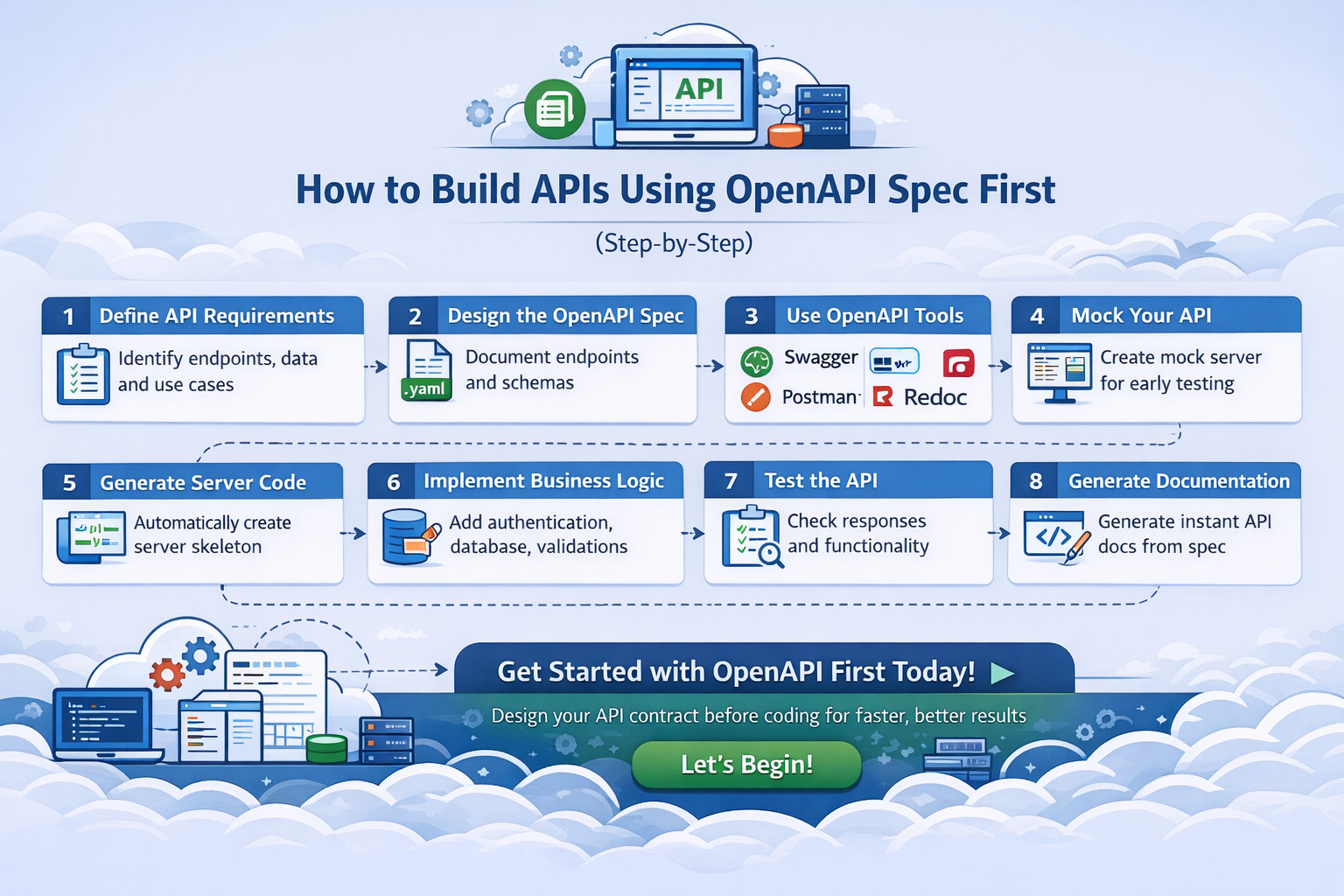
Step-by-Step Guide to Building APIs with OpenAPI
Step 1: Define API Requirements
Start by understanding what your API should do.
Ask questions like:
- What problem does the API solve?
- Who are the users?
- What endpoints are needed?
- What data will be sent and received?
Example:
For an eCommerce API:
- GET /products → fetch products
- POST /orders → create order
Step 2: Design the OpenAPI Spec
Create a YAML or JSON file that defines your API.
Basic example (YAML):
info:
title: Sample API
version: 1.0.0paths:
/products:
get:
summary: Get all products
responses:
‘200’:
description: Success
This file acts as the blueprint of your API.
Step 3: Use OpenAPI Tools
There are several tools to work with OpenAPI:
- Swagger Editor → Design & edit specs
- Swagger UI → Visualize API
- Postman → Test endpoints
- Redoc → Beautiful documentation
These tools help you preview and validate your API before coding.
Step 4: Mock Your API
Before backend development, you can create a mock server using your OpenAPI spec.
Benefits:
- Frontend developers can start early
- Faster prototyping
- Early feedback
Tools like SwaggerHub or Postman allow you to generate mock APIs instantly.
Step 5: Generate Server Code
Use OpenAPI generators to create backend code automatically.
Supported languages:
- Node.js
- Python
- Java
- PHP
This reduces boilerplate and speeds up development.
Step 6: Implement Business Logic
Now, add your custom logic to the generated code.
Example:
- Connect database
- Add authentication
- Handle validations
Your API structure is already defined—you just fill in the functionality.
Step 7: Test the API
Test endpoints using tools like Postman or Swagger UI.
Check for:
- Correct responses
- Error handling
- Performance
Step 8: Generate Documentation
One of the biggest advantages of OpenAPI is automatic documentation.
With tools like Swagger UI or Redoc, your API docs are generated instantly from the spec.
Step 9: Version and Maintain
As your API evolves:
- Update the OpenAPI spec
- Maintain versioning (v1, v2, etc.)
- Ensure backward compatibility
Real-World Example
Example: E-commerce API
OpenAPI defines:
/products→ list products/orders→ create orders/users→ manage users
Workflow:
- Define endpoints in OpenAPI
- Share with frontend team
- Generate backend code
- Implement logic
- Deploy
Result: Faster development and fewer errors.
Best Practices
- Keep your spec clean and well-structured
- Use consistent naming conventions
- Add proper descriptions for endpoints
- Validate your spec regularly
- Use versioning from the start
Common Mistakes to Avoid
- Writing code before finalizing the spec
- Ignoring documentation updates
- Overcomplicating endpoints
- Not validating input/output schemas
When Should You Use OpenAPI First?
Use this approach when:
- Building scalable APIs
- Working in teams
- Creating public APIs
- Need strong documentation
Conclusion
The OpenAPI-first approach transforms how APIs are built. By designing your API contract upfront, you ensure better collaboration, faster development, and cleaner architecture.
Instead of fixing problems later, you prevent them from happening in the first place.