
Introduction
If you’ve ever started a new project and paused at the question, “What architecture should I use?”—you’re not alone. Monolith, microservices, and serverless all promise scalability and performance, but each comes with trade-offs that aren’t always obvious at first.
This post is designed to help you understand the real differences, not just the textbook definitions. By the end, you’ll know when to use each approach—and more importantly, when not to.
What Are These Architectures (In Simple Terms)?
Monolith
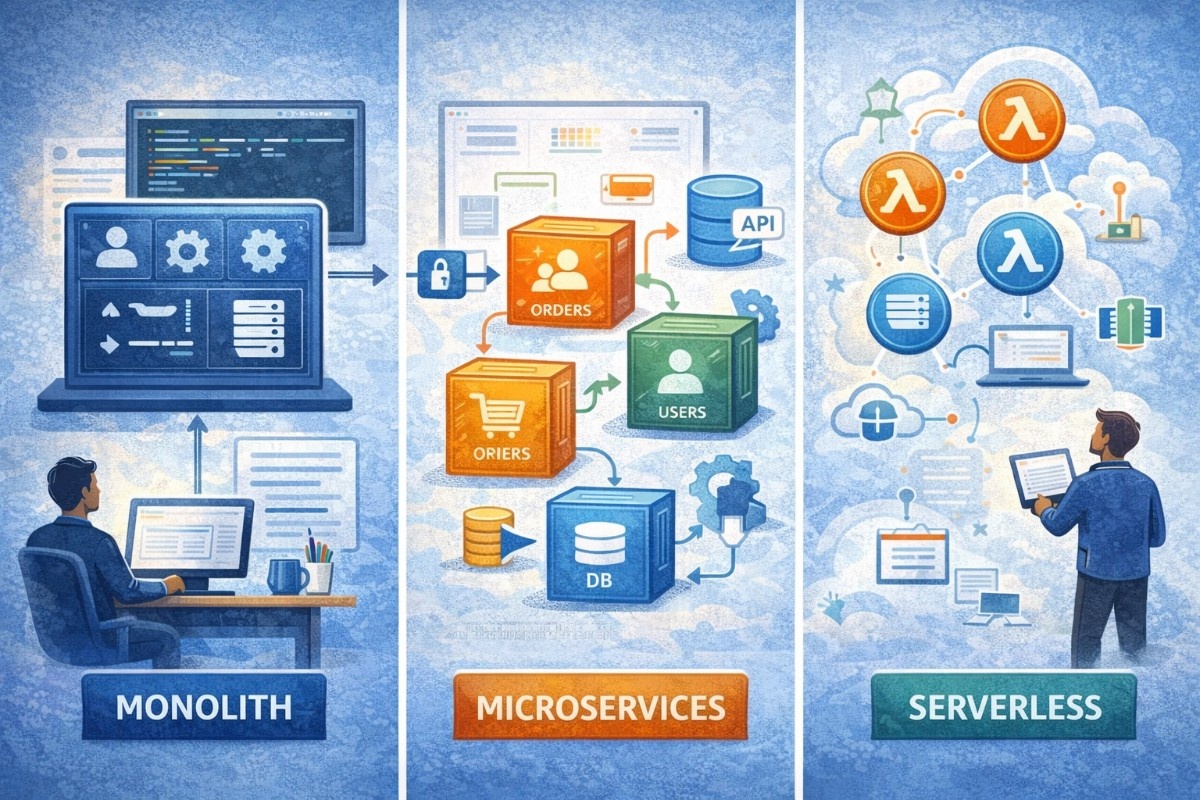
A monolith is a single, unified application where everything—UI, business logic, and database—lives in one codebase.
👉 Think: one big application, deployed as one unit.
Microservices
Microservices break your app into smaller, independent services that communicate over APIs.
👉 Think: multiple small apps working together.
Serverless
Serverless lets you run code without managing servers. You write functions, and the cloud handles scaling.
👉 Think: event-driven functions that run only when needed.
Quick Comparison Snapshot
| Feature | Monolith | Microservices | Serverless |
|---|---|---|---|
| Setup Complexity | Low | High | Medium |
| Scalability | Limited | High | Automatic |
| Deployment | Single unit | Multiple services | Function-based |
| Cost Efficiency | Predictable | Variable | Pay-per-use |
| Maintenance | Easier early | Complex | Depends on design |
How Each Architecture Works (Step-by-Step)
1. Monolith Workflow
- User sends request
- App processes everything internally
- Response is returned
Example:
app.get('/users', (req, res) => {
  const users = getUsersFromDatabase();
  res.json(users);
});
Everything happens inside one application.
2. Microservices Workflow
- Request hits API gateway
- Routed to specific service
- Service communicates with others if needed
Example:
// User Service
app.get('/users', (req, res) => {
  res.json(userService.getUsers());
});

// Order Service (separate service)
app.get('/orders', (req, res) => {
  res.json(orderService.getOrders());
});
Each service is independent.
3. Serverless Workflow
- Event triggers a function
- Function runs and processes logic
- Automatically scales and shuts down
Example:
exports.handler = async (event) => {
  const users = await getUsers();
  return {
    statusCode: 200,
    body: JSON.stringify(users),
  };
};
No server management required.
Where Each Approach Shines
Monolith – Best for Simplicity
- Quick to build and deploy
- Easier debugging
- Ideal for startups and MVPs
👉 Real-world scenario: A small team building a product prototype.
Microservices – Best for Scale
- Independent deployments
- Teams can work in parallel
- Better fault isolation
👉 Real-world scenario: Large applications with multiple teams.
Serverless – Best for Efficiency
- No infrastructure management
- Scales automatically
- Cost-effective for variable traffic
👉 Real-world scenario: APIs, background jobs, event-driven systems.
Where Things Get Tricky
Monolith Challenges
- Hard to scale specific parts
- Becomes messy as it grows
Microservices Challenges
- Complex architecture
- Network latency issues
- Requires strong DevOps setup
Serverless Challenges
- Cold starts
- Vendor lock-in
- Debugging can be harder
How to Choose (Practical Decision Guide)
Step 1: Start Simple
If you’re unsure → start with a monolith
You can always break it later.
Step 2: Evaluate Growth
If your app grows and teams expand → move toward microservices
Step 3: Optimize for Scale & Cost
If your workload is unpredictable → consider serverless
Real-World Insight
Many successful systems don’t stick to just one approach.
👉 They use a hybrid model:
- Monolith for core features
- Microservices for scaling parts
- Serverless for background tasks
Architecture is not a religion—it’s a tool.
Summary
Each architecture solves a different problem:
- Monolith → Best for simplicity and speed of development
- Microservices → Best for scalability and large teams
- Serverless → Best for flexibility and cost efficiency
There’s no “best” option—only the right one for your situation.
What Should You Do Next? (CTA)
Don’t overthink architecture at the start.
Instead:
- Build your next project as a simple monolith
- Identify bottlenecks as you grow
- Gradually evolve into microservices or serverless where needed