

Introduction
Serverless architecture is a modern cloud computing model where developers can build and run applications without managing servers. Instead of provisioning infrastructure, you rely on cloud providers to handle scaling, availability, and maintenance automatically. This allows you to focus entirely on writing code and delivering value to users.
With the rise of platforms like AWS Lambda, Azure Functions, and Google Cloud Functions, serverless has become a popular choice for startups and enterprises alike. But while it offers significant advantages, it also comes with trade-offs that you should understand before adopting it.
What is Serverless Architecture?
Serverless architecture doesn’t mean there are no servers—it simply means you don’t manage them. The cloud provider dynamically allocates resources and executes your code in response to events.
In a typical serverless setup:
- You write small pieces of code called functions
- These functions run only when triggered (HTTP request, database update, etc.)
- You are billed only for execution time, not idle resources
This model is often referred to as Function as a Service (FaaS).
How Serverless Works
Here’s a simple flow of how serverless applications operate:
- A user sends a request (e.g., clicks a button on a website)
- The request triggers a cloud function
- The function executes the required logic
- Data is processed or stored
- A response is returned to the user
This event-driven model ensures efficient resource usage and scalability.
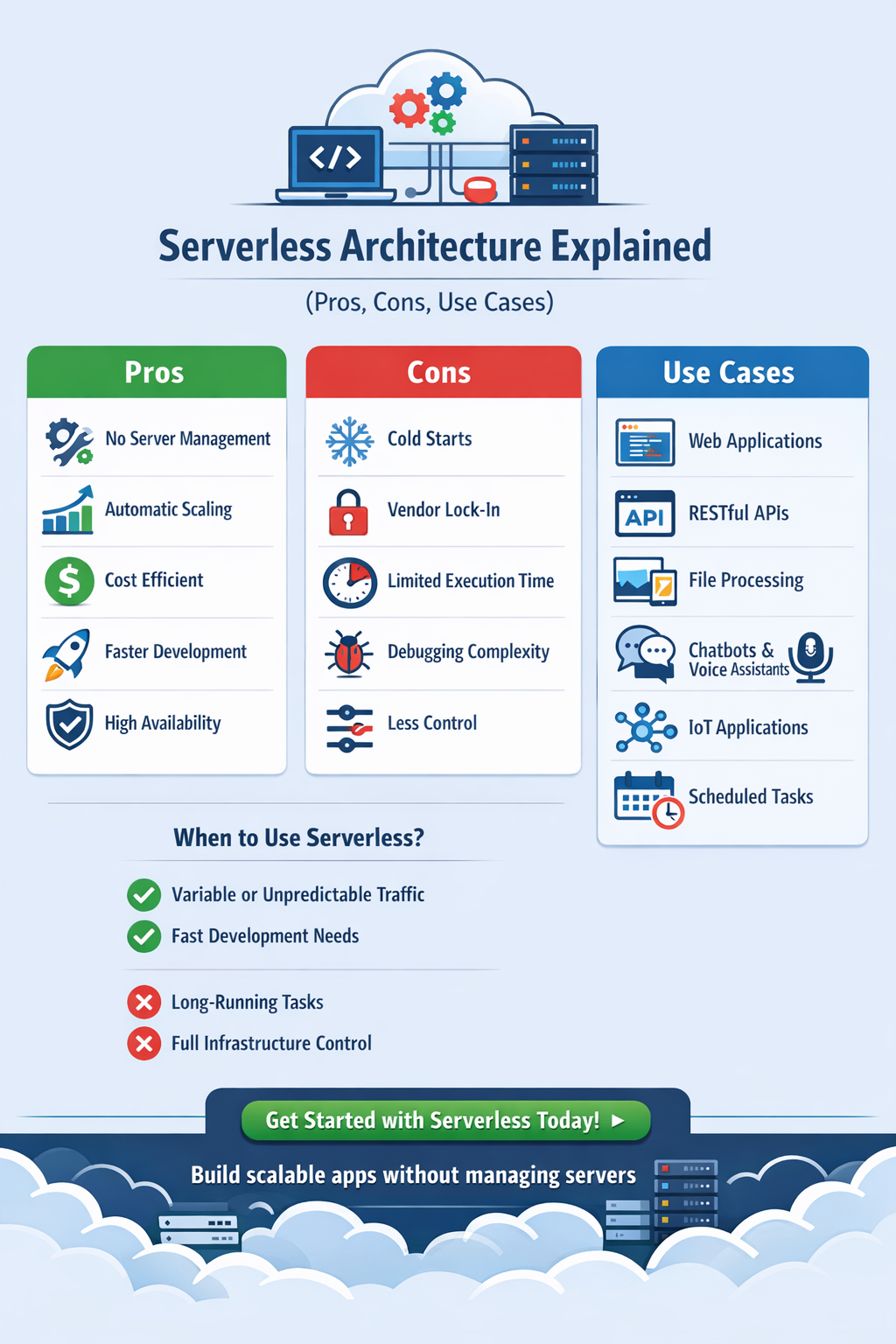
Pros of Serverless Architecture
1. No Server Management
You don’t need to worry about provisioning, patching, or maintaining servers. This reduces operational complexity and saves time.
2. Automatic Scaling
Serverless applications scale automatically based on demand. Whether you have 10 users or 10 million, the system adapts instantly.
3. Cost Efficiency
You only pay for what you use. There are no charges for idle time, making it highly cost-effective for variable workloads.
4. Faster Development
Developers can focus on writing code instead of managing infrastructure, leading to quicker development cycles.
5. High Availability
Cloud providers ensure built-in fault tolerance and redundancy, improving reliability.
Cons of Serverless Architecture
1. Cold Starts
Functions may experience delays when triggered after being idle, which can affect performance.
2. Vendor Lock-In
Each cloud provider has its own ecosystem, making it difficult to migrate applications later.
3. Limited Execution Time
Serverless functions often have time limits (e.g., a few minutes), which may not suit long-running tasks.
4. Debugging Complexity
Monitoring and debugging distributed serverless systems can be challenging.
5. Less Control
You have limited control over the underlying infrastructure, which may not be suitable for highly customized environments.
Common Use Cases
1. Web Applications
Serverless is ideal for building scalable web apps and APIs without managing backend servers.
2. RESTful APIs
You can create lightweight APIs that respond quickly to requests using serverless functions.
3. Real-Time File Processing
Automatically process images, videos, or documents when they are uploaded.
4. Chatbots and Voice Assistants
Serverless works well for event-driven applications like chatbots and virtual assistants.
5. IoT Applications
Handle data from IoT devices efficiently with event-based processing.
6. Scheduled Tasks
Run cron jobs or background tasks without maintaining a server.
When Should You Use Serverless?
Serverless is a great choice when:
- Your application has unpredictable or variable traffic
- You want to reduce infrastructure management
- You need fast development and deployment
- You’re building microservices or event-driven systems
However, it may not be ideal for:
- Long-running processes
- Applications requiring full control over infrastructure
- Systems with strict latency requirements
Conclusion
Serverless architecture is transforming the way modern applications are built. By eliminating the need for server management, it enables faster development, better scalability, and cost efficiency. However, it’s important to weigh its limitations, such as cold starts and vendor lock-in, before adopting it.
If used in the right scenarios, serverless can significantly simplify your development workflow and help you build highly scalable applications with minimal overhead.