

Introduction
Code review is an integral aspect of the software development process. Code reviews guarantee the quality of code and serve as learning opportunities for developers. The introduction of artificial intelligence-driven code review tools raises the following question: have developers become obsolete or simply improved due to technology?
This article will examine the actual nature of AI code review tools, their strengths and weaknesses, as well as their role in the development process.
What Are AI Code Review Tools?
AI code review tools utilize machine learning algorithms to review code. They perform functions such as detecting syntax issues and bugs, recommending code improvements, enforcing code guidelines, finding vulnerabilities in code, and suggesting code refactoring.
Common activities include:
- Syntax error detection
- Performance improvement recommendations
- Code style enforcement
- Code vulnerability identification
- Code refactoring suggestions
They are like a quick, efficient junior reviewer that never gets tired.
AI Code Review Process (How It Works)
Step 1: Submission of Code
A developer commits code to a repository or raises a pull request.
Step 2: AI Review
An AI code review tool analyzes the submitted code by applying pre-trained machine learning models.
Step 3: Provision of Feedback
It suggests, warns, or corrects the code issues.
Step 4: Action by Developer
A developer considers the feedback and accepts or rejects it.
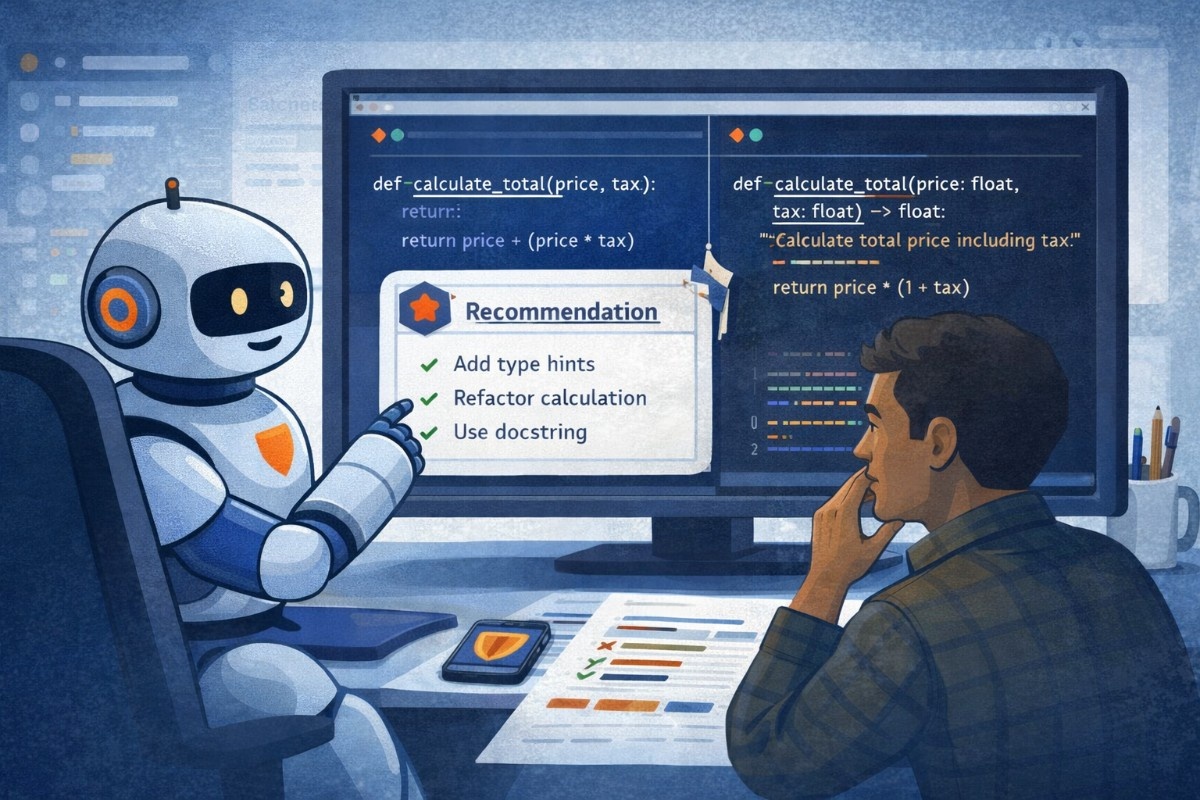
Example: Code Review Using AI
Before Code Review by AI
def calculate_total(price, tax):
    return price + (price * tax)
After Code Review by AI
def calculate_total(price: float, tax: float) -> float:
    """Calculate total price including tax."""
    return price * (1 + tax)
Difference
- Type hint added
- Readability improved
- Calculation simplified
- Documentation added
Although minor, these changes can be multiplied across multiple lines of code.
Advantages of AI Tools
1. Quickness and Consistency
The tool is quick to check the code and maintains consistency.
2. Detecting Obvious Errors
Variables that are not used and basic formatting problems can be easily detected by the tool.
3. Developer Training
Younger developers receive instant feedback from AI without having to wait for senior reviewers.
Where AI Fails to Meet Expectations
1. Insufficient Context Awareness
AI does not fully comprehend business reasoning and objectives related to products.
2. Inferior Judgment in Making Trade-offs
It might recommend “cleaner” code without improving performance or scalability.
3. Not Genuine Cooperation
A code review process is as much about collaboration and knowledge exchange as it is about critique and mentoring.
Do AI Code Review Tools Replace Programmers?
Short answer: No.
Long answer: They change how developers work, but they don’t replace them.
In general, AI code review tools:
- Act as assistants rather than arbiters
- Act as accelerators rather than substitutes
- Serve as safety nets rather than architects
An effective programmer does more than just program; they also:
- Understand requirements
- Decide on design choices
- Manage trade-offs
- Work within teams
AI can support these tasks—but not own them.
The Actual Effect: Developers + AI
This is not the future of AI versus developers; this is the future of AI and developers working together.
The differences:
- Less time spent on review cycle
- Quicker feedback loops
- Better code by default
The similarities:
- Problem-solving
- System architecture
- Human Collaboration
Conclusion
AI-based tools for reviewing code are powerful, efficient, and becoming indispensable—though they will never replace programmers. These tools are simply reducing friction in the development process and allowing programmers to concentrate on what truly counts.
What Should You Do Next? (CTA)
If you’re a programmer or member of a team:
- Experiment with including an AI code review program in your process.
- Let the program take care of mundane tasks and not crucial ones.
- Concentrate your manual reviews on design, reasoning, and teamwork.
Do this slowly, test, and adjust—because those teams that can make use of AI technology will outpace those that can’t.