
Google just rolled out the May 2026 Core Update, and yeah, SEO folks everywhere are already reporting major ranking wobbles on both informational pages and those more niche, tightly focused sites. If you run a website—especially something like a law firm, a local service business, or a site that’s basically content after content —you might have seen traffic drops, impression swings, or keyword positions moving around for no super obvious reason. And no, this isn’t just some “spam only” thing. It’s a broad quality recalibration, meant to lift more relevant, satisfying content for searchers, across all kinds of domains, not only the ones that “follow the rules” better.
In this fairly deep guide, you’ll get a clear picture of what the May 2026 Core Update actually is, what the biggest SEO changes tend to be, who usually gets hit harder, and most importantly how to regain rankings using a more structured, people-first approach, not a mechanical one.
What Is the May 2026 Core Update?
A core update, in simple terms, is a large-scale algorithm shift where Google rechecks how it judges content quality, authority, and relevance across the whole internet. And unlike spam updates or smaller niche adjustments, core updates are meant to make overall search results better, by rewarding pages that genuinely help people, not just pages that look optimized on the surface.
Google has shared a few specifics about the May 2026 Core Update, including :
- Rollout started: May 20–21, 2026
- Expected duration: up to 2 weeks for full completion
- Primary goal: show more helpful, people-first content, while lowering visibility for pages that feel overly SEO-driven thin, or just low-value
Also, this one comes pretty close to Google I/O 2026, where Google talked about AI-driven search experiences, agentic search journeys, and results that are more task-oriented. Search is shifting from “answer the single question” mode to “help the user finish the full thing,” and that really changes how content gets evaluated.
Biggest SEO shifts for the May 2026 Core Update
From early signals, people from the community saying stuff, and a broader industry view, here’s what seems like the biggest moving parts you should grasp right now:
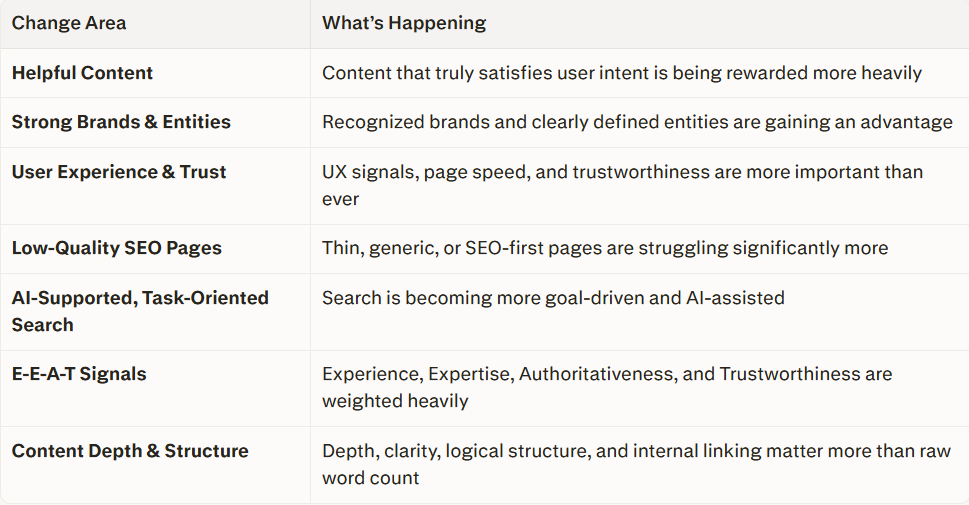
Informational content is showing more volatility than transactional pages. This suggests Google is prioritizing trust, utility, and authentic experience indicators over keyword-stuffed guides or generic content farms.
Who Is Most Likely Hit by the May 2026 Update?
You are more likely to be affected if you observe the following:
-
Sudden drops in impressions or positions in Google Search Console
-
Declines in informational blog posts, guides, or FAQ pages
-
Long-tail keywords slipping 2–3 positions or more
-
Pages with:
-
Outdated content (no recent updates, old statistics, or irrelevant examples)
-
Weak topical authority (covering many topics superficially instead of focusing deeply)
-
Poor internal linking (orphan pages, unclear topic clusters)
-
Thin sections or lack of real insights, original research, or personal experience
-
Transactional and local service pages often remain more stable during quality-focused core updates. This is because they naturally align better with user intent, trust signals, and clear business value.
Step-by-Step Recovery Strategy for the May 2026 Core Update
Google clearly states there’s no single “fix” for core updates. Recovery is about improving your content and site quality over time. Here’s a structured, actionable process to help you recover and even improve your rankings beyond pre-update levels.
1. Check Search Console Data Carefully
Before making any changes, gather data:
-
Identify pages with the biggest impression drops over the last 14 days
-
Review position changes over 7–14 days, not single-day fluctuations
-
Analyze CTR trends before and after the update
Avoid overreacting to single-day data. Core updates can cause temporary volatility before rankings stabilize.
2. Improve Depth, Not Just Word Count
Google is not rewarding longer content for the sake of length. It rewards clarity, usefulness, and depth.
Instead of adding fluff:
-
Expand weak sections with real examples and practical insights
-
Add actionable steps that readers can implement immediately
-
Improve formatting with clear headings, bullet points, tables, and short paragraphs
-
Add a FAQ section targeting related queries people actually ask
-
Update outdated statistics, examples, dates, and references
Clarity wins over volume. A concise, well-structured 1,200-word post that genuinely helps readers will outperform a 3,000-word post full of filler.
3. Strengthen Internal Linking
Google uses internal links to understand how topics are related and how authority flows through your site.
-
Link related posts naturally within your content
-
Build topic clusters around core services (e.g., “family law,” “estate planning,” “personal injury”)
-
Ensure key landing pages receive internal links from supporting blog posts
For example, a law firm could:
-
Link “How to File for Divorce in Ontario” → to “Family Law Services” page
-
Link “E-E-A-T SEO Guide” → to “About Our Firm” and author bios
This strengthens topical relevance and helps Google understand your expertise.
4. Improve Page Experience and Core Web Vitals
Pages with poor user experience tend to decline during quality updates.
Check the following metrics:
-
LCP (Largest Contentful Paint): Should be under 2.5 seconds
-
CLS (Cumulative Layout Shift): Should be under 0.1
-
Mobile responsiveness: Ensure layout works well on all screen sizes
-
Page loading time: Reduce heavy scripts, unoptimized images, and unnecessary plugins
Optimize images, reduce heavy JavaScript, and ensure mobile-friendly layouts to improve Core Web Vitals.
5. Strengthen E-E-A-T Signals
For law firms, local services, and YMYL (Your Money Your Life) topics, E-E-A-T is critical:
-
Add author bios with credentials (e.g., “Licensed Ontario Lawyer, 10+ years in family law”)
-
Showcase case results, testimonials, and verified reviews
-
Link to professional profiles (Law Society, bar associations, professional directories)
-
Publish original insights, not just reshared news or generic summaries
Google wants to see that your content is created by real experts with real experience.
6. Avoid Hasty Deletions
Do not immediately delete underperforming pages. Instead:
-
Improve them with new content, better structure, and updated data
-
Merge thin pages into stronger, comprehensive guides
-
Restructure into topic clusters before considering deletion
Deleting pages can harm your site’s overall authority and topical coverage.
What Google Says About Recovery
Google’s official guidance for core updates remains consistent:
-
“There’s nothing new or special creators need to do for this update as long as they’ve been making satisfying content meant for people.”
-
“We strongly encourage reading our creating helpful, reliable, people-first content help page.”
-
There are no specific actions guaranteed to recover instantly
-
Most significant recovery tends to happen after the next core update, though some improvement can occur between updates
Recovery may take weeks or even months, depending on how quickly and comprehensively you implement improvements.
Practical Tips for Law Firms & Local Canadian Services
Since many of your clients are law firms and local Canadian service businesses, here are tailored tips:
-
Local SEO: Optimize Google Business Profile, ensure NAP consistency, and target local keywords (e.g., “family lawyer in Hamilton, ON”)
-
Service pages: Each core service should have a detailed, people-first page with clear CTAs and trust signals
-
Blog content: Focus on real client questions, not generic “what is…” articles
-
Video content: Add short explainer videos (Google favors video for engagement and dwell time)
-
Voice search: Optimize for natural language queries (“What do I do if…?”, “How much does…?”)
Local SEO and trust signals are especially important for law firms, as clients are making high-stakes decisions.
Key Takeaways
-
The May 2026 Core Update is a quality-focused, broad algorithm change
-
It rewards helpful, experience-driven content and strong brands
-
Recovery is about improving content depth, internal linking, UX, and E-E-A-T, not quick fixes
-
Monitor Search Console, avoid panic deletions, and treat every quarter as a content quality checkpoint
-
Focus on people-first content that solves real problems for your clients
By implementing these strategies consistently, you can not only recover from the May 2026 Core Update but also build a more resilient, trustworthy, and high-performing website for the long term.