
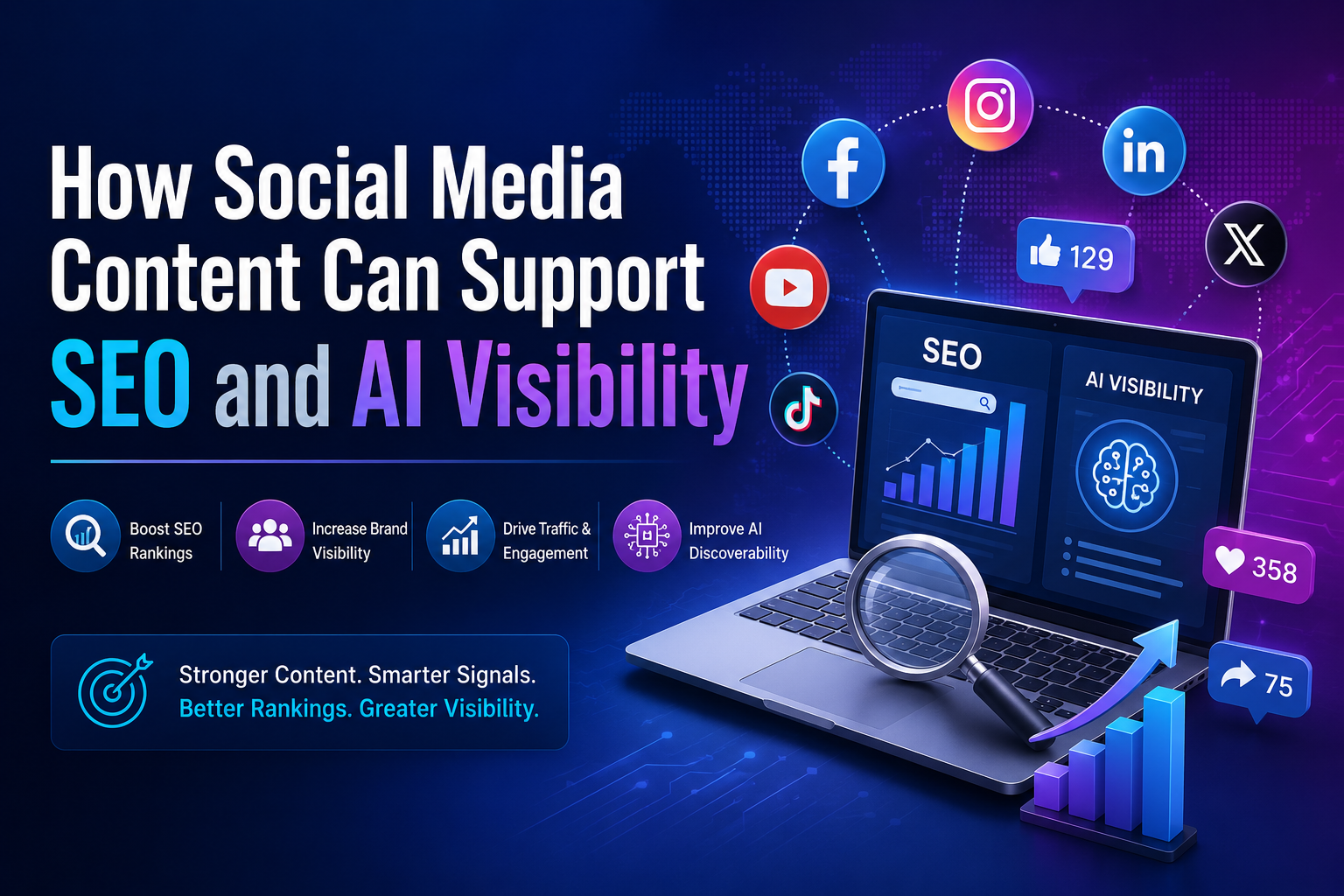
Digital marketing is changing really fast. Companies aren’t only trying to show up on classic search engines anymore. Now, brands have to build authority on social media,and also show up in those newer AI search experiences. Since artificial intelligence is changing how people find info online, the link between social media, SEO, and general digital visibility feels tighter than before.
For a long time, marketers treated SEO and social media like they were separate lanes. SEO was mostly about pushing rankings in search, while social media was more about engagement, growing the audience, and general brand awareness. But that split… doesn’t really match how things work in the modern digital ecosystem.
A lot of search engines, and AI-powered platforms, look at many “trust signals” to judge businesses brands, and content quality. Social media content adds to those signals by boosting brand authority, making the content easier to discover, sending more people to your site, and supporting the idea of real expertise.
If a business understands how social media content can help both SEO and AI visibility, they’re usually setting themselves up for long term results, not just short spikes.
Understanding how social media connects to SEO
One common misunderstanding in digital marketing is the idea that social media doesn’t affect SEO at all. And yes, social engagement by itself usually isn’t a direct ranking factor in Google. Still, social content can strongly influence other things that feed into SEO performance.
Search systems increasingly lean toward authority, trustworthiness, expertise, and user engagement. Social media helps with these, mainly by widening reach and improving how visible the brand becomes.
When businesses publish useful content consistently on social platforms, they create more chances for people to discover, respond, and actually search for the brand later.
Social media brings more qualified traffic to your website
Website traffic is still one of the clearest indicators of digital performance. Social media platforms work like distribution corridors that move people straight to your website content.
A helpful post, a video, an infographic, or an industry point shared on social media can push users to your site to learn more. Whether they land on blog pages, product pages, or service pages, those visits add up to stronger site engagement.
For instance, a business that shares insightful blog posts and keeps promoting them on social media often sees more steady traffic. When traffic increases, there’s also more chance for longer sessions, better engagement metrics, and easier lead generation.
When people keep interacting with valuable material, it builds trust and makes the brand feel familiar. Both of those are essential for long run digital growth.
Content distribution increases reach and helps visibility
Even the best blog content can struggle if it never gets seen. Posting an article and assuming it will rank on its own, just like that, isn’t enough anymore in a crowded online world.
Social media lets businesses amplify content reach quickly. One blog post can turn into a bunch of social assets such as short-form videos, carousel posts, infographics, quote visuals, and education focused snippets.
That approach extends content lifespan too, and it improves discoverability in general.
The wider the distribution, the more likely you are to pick up engagement, shares, backlinks, and mentions, which then indirectly supports SEO performance.
Businesses that blend content marketing with thoughtful social promotion tend to beat competitors who rely only on organic search.
How social media supports SEO performance in practice
Even if social media doesn’t directly “move rankings” the usual way, its effect on the overall SEO plan can be big. Companies that use social platforms with purpose often build stronger online authority and gain better visibility.
- More branded search signals
Brand recognition is becoming even more valuable in search results.
When users keep running into helpful content from a business on social media, they’re more likely to type that business name directly into search engines later. This behavior is called branded search.
So if people repeatedly engage with posts from a company about digital marketing trends, they might later search for that company specifically to learn more.
Branded searches can strengthen trust indicators and show search engines that the business is known, relevant, and connected to a specific niche.
Also, staying active on social helps keep the brand visible and memorable. It stays “top of mind” for customers while they’re deciding what to buy or who to contact.
- Social Media builds authority and trust
Trust is a huge part of digital visibility, like it’s not optional anymore.
Search engines are starting to favor businesses that show real expertise and reliability, not just random updates. And on top of that AI-powered systems tend to lean toward sources they consider authoritative, it’s like they want the “safe pick” not the loud pick.
So if a business keeps posting educational and useful social content, it slowly turns into a credible voice in the industry, which helps a lot.
Some trust-building content ideas, kind of simple but effective:
- Industry insights
- Educational video clips
- Expert commentary
- Case studies
- Problem-solving pointers
- Frequently asked questions
When companies consistently educate their audience, they boost brand authority and online credibility at the same time.
And honestly, authority signals matter a lot for long-term SEO growth and for AI discoverability too.
- More chances for natural backlinks
Backlinks still rank as one of the strongest SEO signals.
Social media spreads your work farther, and that extra exposure often leads to more references from websites, blogs, journalists, and industry publishers.
Like, if you share a detailed industry report, or a sharp infographic across social platforms, publishers that look for dependable resources may notice it.
Even though social shares themselves are not backlinks, the attention you gain can lead to organic linking later on.
That’s why social media works best as a supporting component inside your content marketing strategy, not a standalone “done and done” plan.
Why Social Media matters for AI visibility
AI is changing how people search online.
Instead of listing websites, AI-driven search experiences now summarize info and sometimes answer directly. AI search platforms also tend to evaluate authority, trustworthiness, and topical relevance before surfacing content.
So businesses need stronger digital signals, not just website optimization.
Social media content helps with AI search visibility in a very practical way.
Consistent brand signals help AI “recognize” you
AI systems basically review information from lots of places to decide which brands look trustworthy and credible.
If a business stays active across social platforms, plus websites, blogs, and other channels, that creates clearer identity signals online.
For instance, if the brand keeps sharing content around SEO, branding, web development, or marketing strategies, AI systems slowly connect the business with those subjects.
Consistency helps AI “learn” expertise. A scattered content approach, with random topics, can weaken recognition, while focused messaging builds authority faster.
Social media also supports entity-based search
Modern AI systems are moving toward recognizing entities, not just matching keywords.
Instead of only reading words, AI tries to understand businesses, brands, products, and people as trusted entities.
Social content helps because it repeats and reinforces expertise in certain topics over time.
So if a business keeps publishing content about law, healthcare marketing, real estate, or SEO, it may gradually get recognized as an authority in those areas.
That can increase the chances of appearing in AI-generated recommendations, or in informational summaries.
Video content boosts discoverability
Video is one of the biggest content formats right now.
Short-form videos, educational reels, interviews, and explainer formats help raise engagement and improve visibility.
And AI-powered search systems increasingly analyze video to catch trends, expertise, and audience interest.
If businesses make helpful video content around common questions or industry education, it can improve discoverability across AI and search experiences.
Plus educational video content often improves trust, and retention, because people stick around longer.
Best types of social media content for SEO and AI visibility
Not every social post is equally valuable.
If a business wants stronger SEO and AI visibility, it should prioritize formats that show expertise and deliver real educational value.
Educational content
Educational stuff usually wins because it solves problems and answers questions users actually have.
Examples:
How-to guides
Industry tips
Educational carousels
Explainer videos
FAQ posts
Step-by-step tutorials
This kind of content supports authority-building and it also increases engagement, shares, and that social momentum.
Thought leadership content
When businesses share real expert opinions and industry perspectives, authority grows faster.
Thought leadership helps credibility stand out, and it can separate the brand from competitors.
Industry trends, professional insights, predictions and commentary all signal expertise.
Blog promotion and content repurposing
Blogs shouldn’t sit alone on a website, like an island.
Repurposing blog posts into social updates increases visibility and keeps reinforcing topical authority.
One article can turn into:
Short videos
Carousel posts
Infographics
Discussion posts
Educational snippets
That helps content reach more people, while still supporting SEO goals.
Best practices for combining social media and SEO
If the goal is maximum digital visibility, treat social media and SEO like partners, not separate projects.
- Use keywords naturally
Include relevant keywords in captions, bios, hashtags, and content descriptions.
Just don’t go overboard, readability comes first, because keyword stuffing looks messy.
- Maintain consistent messaging
Keep branding, tone, and expertise aligned.
A unified digital presence improves recognition with both search engines and AI systems.
- Encourage engagement
Comments, shares, saves, and discussions expand reach and increase brand awareness.
Higher engagement also tends to create more visibility opportunities, it’s like the feedback loop you want.
Final Thoughts
Social media content is no longer only a branding thing. It sort of became an essential piece inside modern SEO and, also AI visibility strategies.
It’s doing more than pushing qualified website traffic and boosting authority. It also helps a lot with entity recognition, and plain old discoverability, which feels more and more important for digital success.
Businesses that keep publishing educational, trustworthy and engaging content across social platforms will probably be better prepared to win in both traditional search, and those AI-powered search experiences as well.
And since search keeps changing, tying social media with SEO isn’t just some extra competitive edge, it is turning into a necessity for sustainable online growth.