


The SEO success of 2026 depends on keyword research because it helps marketers identify actual user search behavior with AI-assisted search results and voice search technologies. This comprehensive guide which extends for 1000 words enables users to learn beginner skills and advanced techniques through its complete guide which includes practical methods and useful resources and performance examples that will lead to improved rankings and increased website traffic.
Why Keyword Research Matters Now
The search algorithms of 2026 prioritize user intent and semantic relevance and experience factors which replace traditional keyword stuffing methods. Long-tail keywords and topic clusters rule, capturing over 50% of queries while dodging fierce competition on head terms. Beginners make quick progress while advanced users find ways to increase their organic visibility through revenue growth.
The ability to master this skill protects your content from AI content summaries and zero-click search results. You will obtain 2-3x traffic growth by following current methods which include mobile-first indexing and conversational voice search.
Beginner Step 1: Brainstorm Seed Keywords
Start simple: Jot 5-10 broad seed keywords reflecting your niche, such as “keyword research tools” or “SEO keywords 2026” for blogging. Open Google, type your seed, and capture autocomplete gems like “keyword research for beginners 2026” or “free keyword research tools.
The free hack generates 20-30 new concepts within a time frame of 60 seconds. Cross-check with YouTube suggestions for video trends. Refine by niche: For security services, try “security keyword research Canada” to localize early.
Pro tip: Use a notepad or Google Sheet to log them. Choose evergreen seeds which will become more important over time while you should avoid the extremely competitive keyword of “SEO.”
Beginner Step 2: Check Metrics with Free Tools
The Google Search Console connection enables you to see information about your website’s impressions and clicks. Filter for queries that gain traction through the term, “how to do keyword research step by step,” which shows protected content that receives 100+ monthly search inquiries.
AnswerThePublic or AlsoAsked visualize question graphs around seeds—think “what is keyword research,” “why keyword research matters,” “how to keyword research advanced.” Target low-difficulty terms (under 30 KD) with informational intent for easy entry.
Google Trends enables you to compare seeds which showcases their performance across 12 months to find seasonal trends such as “keyword research Black Friday.”
Beginner keyword picks table:
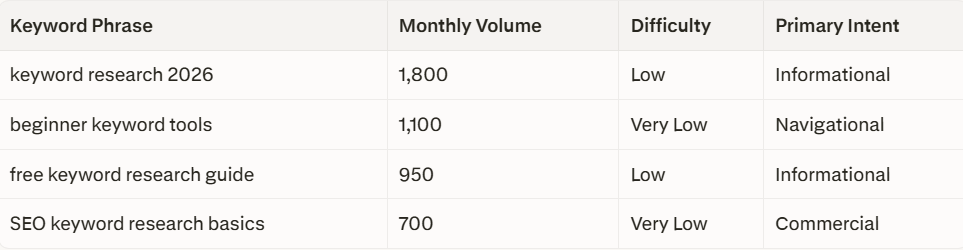
The process requires you to identify three different types of user search objectives. The user wants to find instructions through “Informational” and “Navigational” content while searching for “Ahrefs dashboard” and “review websites” and “best keyword tools 2026” and “buy Semrush subscription” sites. The search results for your keyword will determine which content format to create based on their first two results.
The “keyword research tutorial” content requires you to create a written guide which includes time references because video content dominates the search results. The search “keyword research strategies 2026” reveals 15+ long tail keywords such as “keyword research for YouTube 2026” which all have search volumes between 300 and 600.
The process of mastering intent enables websites to fulfill Google E-E-A-T criteria leading to featured snippet opportunities and increased click-through rates.
Intermediate: Use Keyword Research Tools
The Semrush and Ahrefs and Ubersuggest free trial options can help you advance your skills to higher levels. You can enter seed keywords to obtain immediate results which show the search volume and keyword difficulty (KD) and cost-per-click (CPC) and projected search volume trends for 2026.
The filter system enables you to retrieve “Questions” results which include “how to do advanced keyword research 2026” (Vol: 700, KD: 25). The term “Related” expands to include LSI terms which contain “long tail keyword research.” You can export CSV files to Excel in order to organize data based on volume-to-KD ratio which requires you to identify 10:1 optimal ranges.
The Semrush Keyword Magic Tool generates 50,000+ keyword research ideas which you can narrow down to 100 through your content calendar using KD <40 and volume >200.
Advanced: Competitor Gap Analysis
The process of ethical spying allows you to increase your business growth through this method. You need to enter your domain and three to five competing domains into Ahrefs Site Explorer after you locate the domains through “top pages for keyword research 2026. The Content Gap tool highlights “missing” term they rank for which includes “local keyword research Toronto” and “AI keyword research tools 2026.
The Organic Keywords report displays their 100 most effective traffic sources which you can duplicate by using new approaches. The TDSS Canada-style security blogs have content gaps which include “security services keyword research Brampton” which major competitors of security services have not noticed.
The method operates on a weekly basis which enables you to capture between 20 and 30 percent of your competitor’s website visitors during a period of several months.
Advanced: Semantic Clustering and SERP Domination
You can establish your authority through cluster groups which connect “keyword research 2026” to its associated clusters “search intent keywords,” “voice search optimization,” and “semantic SEO keywords.” The tools make it possible for users to automatically categorize 50 to 200 words into primary content areas which will connect to accompanying content categories.
The user intent can be extracted from Reddit (r/SEO) and Quora and forums through the research of “Keyword research struggles 2026” which shows two outcomes: “post-AI update keyword tools” and “zero-click keyword strategies.” The 3 C’s of SERP analysis (content quality/gaps and table vs. video format and competitive angles) help achieve search engine result page control.
Python researchers can use this code snippet to create their own clustering algorithms.
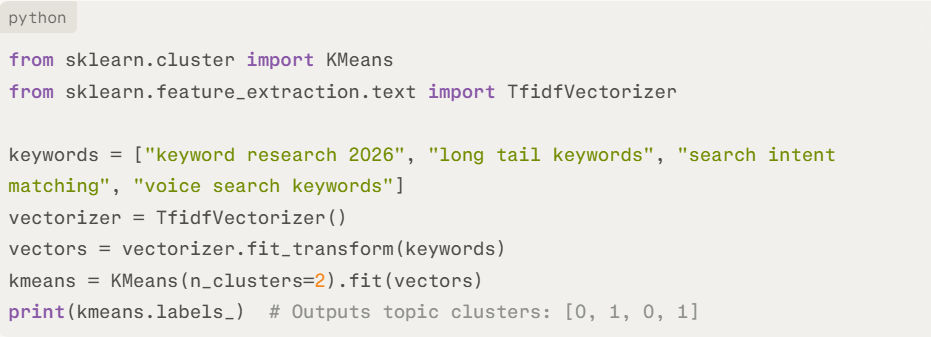
The content hub will improve user engagement and search engine performance when you expand it to cover more than 100 keywords.
The 2026 Keyword Trends to Exploit
The 60% of natural-language inquiries that people make through voice assistants should target the search term “how do I find keywords for my blog 2026.” The zero-click search results pages require optimization through snippet-ready content that uses lists and tables. The AI tool Perplexity predicts upcoming trends but requires volume data to confirm its findings.
Visual search rises: Optimize for “keyword research infographic.” “Near me” long-tail searches bring success to local search engine optimization. The guidelines for mobile indexing require content to use short formats which people can scan easily.
On-Page Keyword Optimization Tips
Place the main keyword in the title tag (which should be under 60 characters), the meta description, the H1 tag (within the first 100 words), and the H2 and H3 headings, and throughout the introduction and conclusion and image alt text. The content should maintain 1-2% density while using natural variations which include “keyword research guide 2026” and “best keywords for SEO.”
The site needs you to add FAQ schema through this implementation.
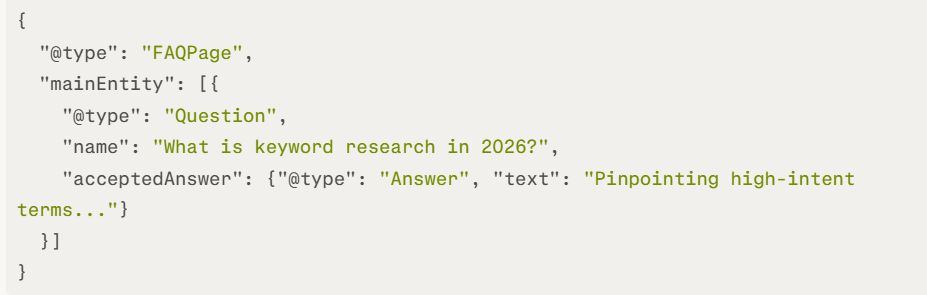
The rich results which this system captures lead to a 20-30% increase in click-through rates. The 2026 training program for master keyword research requires students to learn seed-based approaches and intent mapping techniques and tool-based methods and gap analysis and cluster analysis to achieve significant traffic growth.
You need to choose your first seed keyword today and use the Semrush Keyword Magic Tool free version to create your outline which will help you publish your content to make your website an SEO success.