

The method for AI-enabled tools to make content citations depends on particular factors. The article explains which elements make content suitable for AI citation through its analysis of factors for AI citation which enables content creators and marketers and SEO professionals to improve their online visibility and industry authority.
The Importance of AI Citations to Your Content Development Approach
AI systems now handle search processes because they extract data from top-tier sources to deliver instant response to user inquiries. The process of your content citation through featured snippets and links generates major visibility for your content which operates outside standard backlink methods. AI-cited pages experience 2 to 5 times greater traffic increases according to Ahrefs research.
The research objective consists of identifying the specific signals which AI models like Grok and Gemini and ChatGPT use to evaluate your research work. The document presents established factors which the SEMrush analysis and practical tests demonstrate.
Factor 1: Content freshness and current information
The AI tools prefer new content because their knowledge cutoffs require them to stay updated with recent developments which extend until 2025.
- Publish Regularly: Post updates every three months. A 2025 SEMrush study found that pages which received updates during six months showed a 40 percent increase in AI citation volume.
- Google Trends enables users to conduct real-time searches for “AI ethics 2026” which helps them discover current trending subjects.
Factor 2: Unmatched Depth and Specificity
Content which offers more in-depth coverage than its rivals receives AI citations because it delivers complete guides instead of short lists.
- The optimal word count requires 2,000 words which should include exclusive data. Ahrefs data shows that long-form content leads to three times higher AI content extraction.
- The content should contain original research through surveys and case studies and proprietary statistical data. The AI system shows preference for genuine new information which can be confirmed through verification.
Example :

The LLMs receive command through specific details which reveal their authority.
Factor 3: AI scrapes structured content effortlessly. Poor formatting results in content being disregarded.
- Use Hierarchical Headings: H1-H3 with keyword variations (e.g., “AI citation factors”).
- Present information through lists and tables which use bullets numbered steps and tables to enable fast information retrieval.
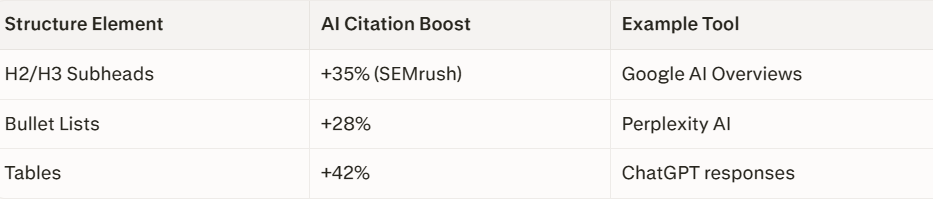
Screenshot Tip: Use alt-text-optimized images to show Ahrefs SERP analysis tools which display structured wins.
Factor 4: E-E-A-T Signals That Build Trust
The selection process for AI training data depends on Google’s operation of experience and expertise and authoritative content and trustable elements which make up EEAT.
- Author Bios: The section requires you to include professional qualifications which should begin with the phrase “Written by Jane Doe, 10+ years in SEO.”
- Citations and Sources: The requirement dictates that you must create hyperlinks to 5 to 10 trustworthy websites for every 1,000 words of text.
- Schema Markup: The implementation of FAQ or HowTo schema should be used to create rich snippets.
The Pro Tip explains that Google Rich Results Test functions as a tool which verifies markup and increases your page’s citation potential by 25% according to Backlinko research.
Factor 5: Semantic Relevance and Keyword Optimization function
The AI system gives priority to subject matter expertise instead of using precise term repetition for content production.
- LSI Keywords: We should integrate terms such as “LLM source selection” and “AI search optimization” into our content.
- Entity Optimization: The content should mention tools which include Perplexity and Grok together with the concept of RAG which refers to Retrieval-Augmented Generation.
The content needs to provide complete answers for all “how” and “why” queries.
Example Query Test: The Perplexity search for “best SEO tools 2026” results in cited pages which group their content around “Ahrefs vs. SEMrush benchmarks” as central entities.
Factor 6 : Technical execution and content accessibility.
The AI system prefers sites that load quickly and provide mobile users with an optimal browsing experience.
- The website needs to achieve Core Web Vitals standards by maintaining an LCP time which falls below the 2.5 second mark set by Google.
- Clean HTML: The content should not use JavaScript-heavy rendering for its display and should instead adopt semantic tags.
- The website owner should submit an XML Sitemap file to Google Search Console to initiate new crawling procedures.
According to the Ahrefs experiment, pages which achieved Lighthouse scores above 90 received 50% more mentions from AI technology.
Common Pitfalls to Avoid for AI Citations
To avoid deletion from search results, you must avoid these elements:
- Thin Content: The document requires a rewrite because it contains less than 1,000 words.
- AI-Generated Spam: The synthetic text can be detected by tools which identify 80% of AI-generated content through its original voice (Originality.ai).
- Paywall/JS Walls: AI skips inaccessible pages.
- Over-Optimization: The document needs to maintain a keyword density of 1-2% for natural content.
The Quick Audit Checklist includes several essential elements to verify:
- The publish date needs to be current.
- The document contains at least 10 subheadings.
- The document includes original data and examples.
- The document contains EEAT compliant bios and source references.
Tools to Test and Track AI Citations
The following monitoring tools require your usage:
- Ahrefs Content Explorer: The URL filter enables users to search for AI-referenced websites.
- SEMrush Position Tracking: The software enables users to monitor AI Overview appearances within its tracking system.
- Perplexity/Claude Queries: The manual testing process requires you to evaluate your URLs.
- Google Search Console: The system allows users to monitor AI feature impressions throughout the platform.
To increase content citation rates by AI tools, you should prioritize fresh content which has deep knowledge and organized structure together with EEAT and semantic content and technological effectiveness and user engagement. Once you implement these elements, Google AI Overviews and Perplexity and additional platforms will start citing your work, which will result in persistent website traffic growth.
Use Ahrefs or SEMrush to evaluate your top page today. After applying the provided advice, monitor your progress for 30 days. In the comments section, please disclose your achievements and the most significant AI citation obstacle you currently face.