

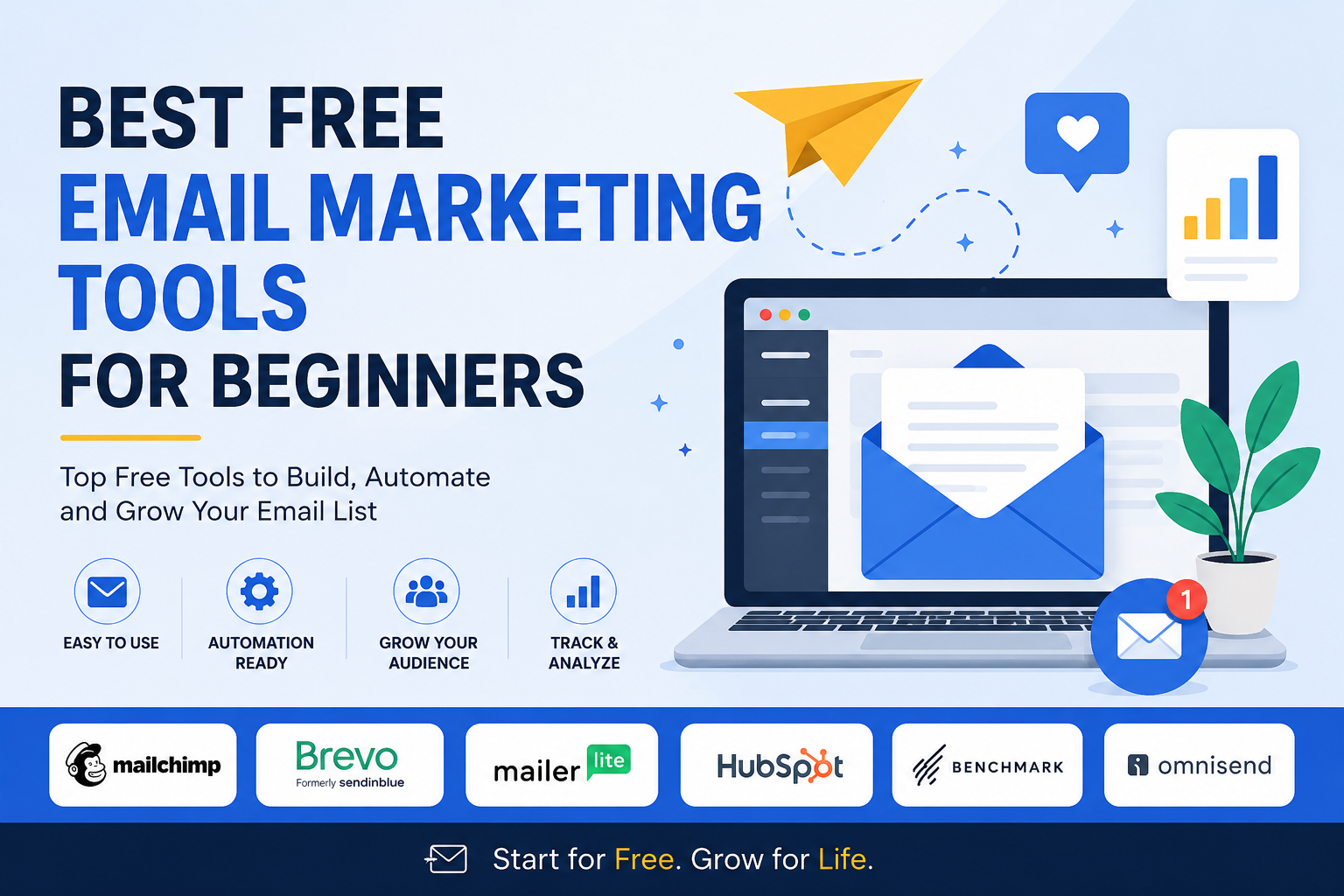
Email marketing is still one of the most reliable digital marketing moves, for businesses big or small. And ok, social media changes all the time, new trends, new stuff, but email keeps doing that steady engagement thing, building better customer ties, and usually gives a solid return on investment. For startups, small biz owners, bloggers, and people basically running on caffeine , it can be one of the smartest ways to reach potential customers directly.
Still, beginners often pause because they think email tools are expensive or kind of hard. But honestly there are a few platforms with free plans that are built with beginners in mind. These options help you craft professional campaigns, set up automated emails, grow your subscriber list, and look at results, without needing heavy tech skills.
In this little guide, we’ll look at the best free email marketing tools for beginners , compare what each platform actually does, and help you pick one that grows your business without drama.
Why Email Marketing Matters for Beginners
Before you choose an email marketing platform, it helps to understand why email marketing belongs in your strategy.
Unlike social media where your reach depends a lot on algorithms, email is more… direct. Every person who subscribes to your list has already shown some interest in what you offer, so they’re more likely to open, click, and care about your updates.
Here are some big benefits you’ll usually see:
- Builds stronger customer relationships
- Drives higher conversion rates
- Improves brand awareness
- Nurtures leads effectively
- Brings consistent traffic back to your site
- Shows measurable marketing results
And there’s the practical part too, email marketing is cost-effective, which is perfect when you’re starting out and your budget is not exactly flexible.
1. Mailchimp – Best for Small Businesses and Beginners
If someone asks for the best free email marketing tools, Mailchimp is usually at the top of the conversation.
It’s known for being simple, with an interface that feels friendly, and setup that doesn’t waste your time. For anyone taking their first steps in email marketing, Mailchimp tends to feel like the easiest landing.
Key Features:
- Drag-and-drop email editor
- Pre-designed templates that look professional
- Basic automation for emails
- Subscriber segmentation
- Performance tracking and reporting
Mailchimp lets you build campaigns that look polished, no coding , and no design degree required. Beginners can launch newsletters, promotions, and welcome campaigns from a dashboard that mostly makes sense.
Why Beginners Pick Mailchimp
Because it’s intuitive, and it keeps the process clear even if you have zero experience.
Best For:
Small businesses, bloggers, startups, and freelancers.
2. Brevo (Formerly Sendinblue) – Best for Email Automation
Brevo has become a serious option in the email marketing world, especially if you want automation but still need a free plan.
If your aim is to automate customer communication without spending, Brevo can fit that role pretty well.
Key Features:
- Advanced email automation workflows
- SMS marketing integration
- Professional email templates
- Contact list management
- Real-time analytics and reporting
One of Brevo’s strongest points is its automation capability. New users can set up welcome emails, abandoned cart reminders, and follow-up sequences without needing to overthink it.
Why Beginners Pick Brevo
It gives you both ease of use and deeper functionality, so you can scale as your business grows.
Best For:
Businesses that care most about automation and customer engagement.
3. MailerLite – Best for Simplicity and Ease of Use
If you want something clean and straightforward, MailerLite is one of the more dependable picks.
The interface is minimal, so making a campaign is simple, but it doesn’t throw away useful marketing features.
Key Features:
- Drag-and-drop campaign builder
- Landing page creation
- Email automation
- Subscriber segmentation
- Signup forms and popups
MailerLite is appealing to beginners because it avoids unnecessary complexity. It’s like, you get what you need, and not 30 extra things you don’t.
Why Beginners Pick MailerLite
It’s easy to navigate, feels intuitive, and the free plan still gives solid functionality.
Best For:
Freelancers, bloggers, creators, and startups.
4. HubSpot Email Marketing – Best All-in-One Marketing Solution
HubSpot does way more than just email marketing. It’s basically an integrated marketing platform, designed to help manage customer relationships while improving how you communicate as a business.
If you’re planning for long-term growth, HubSpot can feel like a strong value move.
Key Features:
- Professional email builder
- Built-in CRM system
- Email tracking and analytics
- Contact management tools
- Marketing automation features
What makes HubSpot stand out is the way it centralizes customer interactions inside a single dashboard, so you’re not hopping between random screens all day.
Why Beginners Pick HubSpot
Beginners who want more than email alone often like HubSpot, because it supports lead management, sales tracking, and marketing automation too.
Best For:
Growing businesses, and service-based companies.
5. Benchmark Email – Best for Quick Campaign Creation
Benchmark Email is made for users who want simplicity, but still want their emails to look professional.
With this platform, beginners can assemble visually attractive campaigns within minutes. Not hours, not a whole project, just quick results.
Key Features:
- Responsive email templates
- Drag-and-drop editor
- Marketing automation
- Signup forms
- Campaign reporting tools
Benchmark leans hard into ease of use, which is great for businesses that don’t have a dedicated marketing team.
Why Beginners Pick Benchmark
Because it’s straightforward, and it helps you publish campaigns quickly and efficiently.
Best For:
Small businesses and entrepreneurs.
6. Omnisend – Best Free Email Marketing Tool for eCommerce
If you run an online store then Omnisend is kinda one of the best free email marketing platforms for eCommerce folks. Like, it’s made for that in a pretty direct way, not some generic thing you have to “fit”.
And unlike regular email tools, Omnisend comes with stuff that helps sell more products, a bit more than just newsletters.
Key Features:
- Cart abandonment emails,
- Product recommendation automation
- Email and SMS integration
- Signup forms and popups
- Automated workflows
With these, online businesses can boost conversions, plus keep customers coming back longer.
Why Beginners Choose Omnisend
The platform keeps email marketing simple for online stores, while the automation does real work that backs revenue growth… kind of quietly, but still.
Best For:
Shopify, WooCommerce, and eCommerce businesses.
7. Moosend – Best for Affordable Business Growth
Moosend is also beginner-friendly and it mixes affordability with solid marketing features. It kinda gives more advanced functionality without making new users feel lost, or like everything is too much at once.
Key Features:
- Email campaign builder
- Automation workflows
- Audience segmentation
- Analytics and performance tracking
- Landing page tools
Why Beginners Choose Moosend
Many people pick Moosend because it’s straightforward to operate, and the upgrade paths are reasonably priced when scaling turns into a must-do.
Best For:
Growing startups and small businesses.
How to Choose the Right Free Email Marketing Tool
Picking the right option depends on what you actually want to achieve, how big your audience is, and where you’re heading next.
Here are some things beginners should check, and not just click through:
- Ease of Use
Look for software with a clean interface, plus a drag and drop editor that doesn’t fight you.
- Free Plan Limitations
Be sure to review subscriber limits, monthly email allowances, and any feature caps.
- Automation Capabilities
Automation means you save time, but also you can communicate more effectively without doing everything manually.
- Design and Templates
Templates that look professional help emails look trustworthy and more “real”.
- Analytics and Reporting
When you track campaign performance, you can fine-tune future campaigns instead of guessing.
Best Practices for Email Marketing Beginners
Using the right tool is only half the game, honestly. Your plan is just as important, maybe even more.
Build an Organic Subscriber List
Try to grow subscribers using website forms, newsletters, and offers that feel valuable not random.
- Create Strong Subject Lines
Great subject lines improve open rates in a noticeable way, so don’t treat them like an afterthought.
- Personalize Communication
When emails match what customers care about, engagement usually goes up. Simple.
- Prioritize Valuable Content
Don’t flood people with “BUY NOW” style messaging. Instead, share educational content, updates, offers, and useful insights.
Optimize for Mobile Devices
Most people open emails on smartphones, so mobile responsiveness matters a lot, yes.
Common Email Marketing Mistakes to Avoid
A lot of beginners run into issues because they do mistakes they could’ve avoided, like:
- Sending too many promotional emails
- Ignoring audience segmentation
- Using misleading subject lines
- Not analyzing campaign performance
- Buying low-quality email lists
If you avoid these, your engagement usually improves, and your campaigns last longer with better results.
Conclusion
Finding the best free email marketing tools for beginners doesn’t need to be confusing or complicated. Whether you care most about automation, simplicity, eCommerce integration, or even CRM functionality, there’s a free platform that can match your needs.
Mailchimp stays a strong pick for beginners, Brevo is great for automation, MailerLite leans into simplicity, and HubSpot gives a more complete marketing solution for businesses. Meanwhile, Omnisend is especially effective for eCommerce stores trying to increase sales.
The right email marketing tool can help you build better customer connections, boost engagement, and grow without huge upfront costs.
Start with a free platform, learn the fundamentals, and slowly build an email marketing strategy that actually delivers measurable results over time, not just “activity”.