

Internal linking remains one of the most beneficial SEO strategies which provides maximum returns on investment to developing websites. When used correctly, it enables Google to assess your website layout while transferring link power to essential pages and maintaining user engagement with your content. This article provides you with an effective internal linking method which you can use to create links across your entire website, which contains more than 500 pages and lacks an SEO department.
The tutorial shows you how to conduct link audits while selecting anchor text and establishing page priorities and creating a scalable linking system for your website’s development.
What Internal Linking Is and Why It Matters for SEO
Internal links function as hyperlinks which connect one page of your website to another page on the same website. You have complete control over these links because they differ from backlinks. Websites use this underutilized SEO tool because they view it as the most unexploited SEO tool.
3 ways internal linking impacts rankings:
The three methods of internal linking affect search engine rankings in three distinct ways.
- Search engines use links to find new web pages which helps them create their index. Search engines use links to discover pages which results in orphan pages not being indexed because they lack internal links.
- The combination of anchor text and nearby content provides Google with information about the topic of the destination page. The method strengthens your keyword themes through its implementation.
- PageRank continues to hold importance because it affects the distribution of link equity across web pages. Internal links which require strategic placement enable the transfer of website authority from popular blog posts and the homepage to both revenue-generating pages and newly published content.
Develop your strategy by using these key SEO terms which include internal linking for SEO, site architecture, link equity, anchor text optimization, crawl depth, pillar page, topic clusters, orphan pages.
Step 1: Map Your Site Architecture With a Pillar and Cluster Model
Random internal linking creates a flat, confusing site. A deliberate architecture does the opposite.
How to structure it:
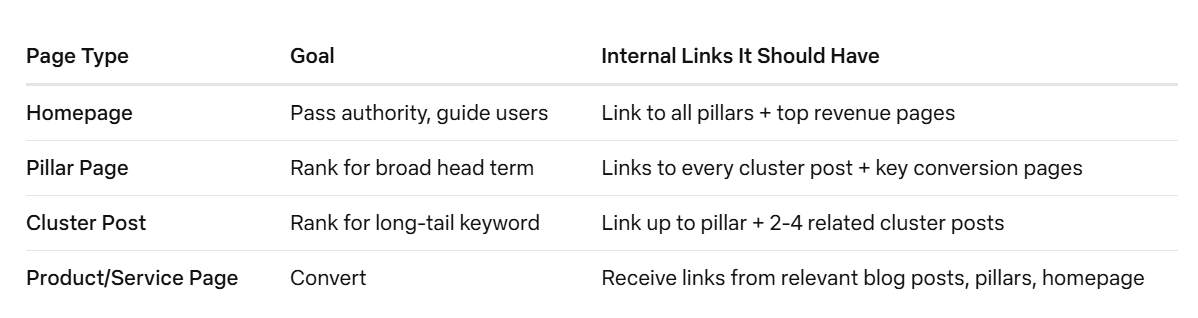
- Identify pillar pages: These are comprehensive guides targeting broad, high-volume keywords. Example: “Complete Guide to Technical SEO”.
- Build topic clusters: Create 5-15 supporting posts that cover subtopics in depth. Example: “How to Fix Crawl Errors”, “XML Sitemaps Explained”, “Robots.txt Best Practices”.
- Link clusters to pillars and to each other: Every cluster post should link up to the pillar using descriptive anchor text. The pillar should link down to each cluster post. Related cluster posts should link sideways where relevant.
Quick audit check: Can a user reach any important page in 3 clicks or fewer from your homepage? If not, your crawl depth is too high and you are diluting link equity.
Step 2: Run a Fast Internal Link Audit to Find Opportunities
The existing links require repair work before you can proceed with adding new ones. The process lets you begin without needing costly equipment.
DIY audit process:
- Find orphan pages: You need to compare your sitemap URLs with the “Pages” report in Google Search Console to identify orphan pages. Pages which show no impressions and no internal links exist as likely orphan pages.
- Check crawl depth: The free version of Screaming Frog or Ahrefs should be used for this task. You need to export all URLs and then sort them according to “Crawl Depth”. Anything 4+ clicks from home should be pulled closer with new links.
- Identify pages with link equity to share: Your blog should be sorted according to organic sessions to find shares. Your top 20 traffic pages are perfect sources to link out from.
Step 3 : Anchor text functions as the clickable text which users access through hyperlinks.
Google uses it as a ranking signal but over-optimization creates a spammy appearance.
- Best practices for anchor text implementation require descriptive links which should not use “click here” or “read more” instead of “internal linking audit checklist” as the replacement link.
- The page content needs to match search intent because users who want to learn “how to fix broken links” should use that exact term or its close alternatives.
- The links to the same destination page should include 3 to 4 different anchor text variations for every 10 created links. Example: “internal linking strategy”, “how to add internal links”, “SEO internal link guide”.
- The writing needs to sound natural because human readers should be the primary audience. The sentence needs to be rewritten when it becomes difficult to understand.
Examples of good vs bad:

Step 4: Add Internal Links Systematically as You Publish
The process of adding links after content creation becomes difficult. The publishing process should include this feature to create better website structure through each new article.
The 5-link minimum rule requires all new blog posts to contain:
- 1 link which directs to its main pillar page
- 1 link which leads to the closest relevant subtopic or product page
- 2-3 links which connect to other articles within the same content cluster
Use these link placement techniques to achieve your strongest results:
- Above the fold: Links which appear at higher HTML positions receive greater weight. The first 2 paragraphs should include 1-2 links which relate to the content.
- Within body content: Contextual links inside paragraphs pass more relevance than footer or sidebar links. The system produces automatic related articles which function as acceptable alternatives to replace manual contextual links.
- The WordPress “Link to existing content” search box enables users to locate content. The content team can use this screenshot to learn how to find older posts for linking purposes without leaving the editor.
Each new blog post must include 5 links according to this rule:
- 1 link should connect to the pillar page of the post.
- 1 link should lead to the most closely associated subtopic or product page.
- 2-3 links should connect to other articles that are part of the same topic cluster.
- The best places for links will create the strongest results.
Step 5: Scale with Smart automation but keep a Human Touch
Websites containing more than 1000 articles require automated systems to handle linking tasks since manual methods fail to meet their operational demands. The process requires automated systems to identify potential linking opportunities which will then undergo manual verification.
The following items and methods provide assistance:
- Link Whisper or Internal Link Juicer: These WordPress plugins suggest relevant internal links based on the specified keywords you enter.
- The search operators enable users to search for specific terms across their website by entering site:yourdomain.com “keyword phrase” to find prior articles that require linking updates.
- The “Links” > “Internal links” report in Google Search Console displays pages that lack sufficient internal links. Sort ascending to find priorities.
What not to automate: Footer links to every page, sitewide sidebar links, or exact-match anchors at scale. These patterns caused penalties during Google’s Penguin updates and still look manipulative.
Step 6: Measure Impact and Iterate Monthly
The process of internal linking requires ongoing maintenance after initial implementation. SEO professionals should treat internal links as they do other SEO techniques.
Metrics to watch:
- Crawl stats: In GSC, look for increased pages crawled per day after fixing orphan pages.
- The average position of target keywords shows that internal link addition to pages results in a 2-5 position increase within 2-4 weeks.
- Internal links that function effectively lead to better session pages and lower bounce rates since they generate more user activity which supports improved search rankings.
- The indexation rate represents the percentage of submitted sitemap URLs that achieve actual indexing status. The target should exceed 95%.
Example: A SaaS client added 3 contextual links from their top blog post to a new feature page. The feature page advanced from position 14 to position 6 within 18 days after the SaaS client added 3 contextual links from their top blog post to a new feature page. Internal links serve as a tool for Google to determine the contextual relationship and significance of page content.
Common Internal Linking Mistakes to Avoid
- Only linking from new to old: You should visit high-authority posts which already exist to insert links toward your new material. This process enables rapid link equity distribution.
- Link blocking through nofollow: Allow link equity to flow through all content except for login and cart pages.
- Creating link chains 10 clicks deep: The website should provide access to essential pages through 2-3 clicks starting from the homepage.
- Ignoring navigation and breadcrumbs: These are sitewide internal links. Category and product pages should use keyword-based breadcrumbs for their internal linking system.
Summary
Internal linking for SEO works because it aligns with how search engines crawl and how humans read. The first step involves establishing pillar pages along with topic clusters which will enable the development of a defined website structure. The audit process needs to identify orphan pages along with items that create deep crawling paths. The publishing procedure requires you to establish a practice of creating links through descriptive anchor text while establishing a base of five links per post. Use tools for scaling purposes while you reserve final decision-making to human operators. The process ends with you demonstrating impact through indexation tracking and evaluation of ranking performance and user engagement metrics.
A strong internal link structure distributes link equity, improves crawlability, and reinforces topical authority. This particular SEO method delivers increasing returns without necessitating continuous advertising expenses.