

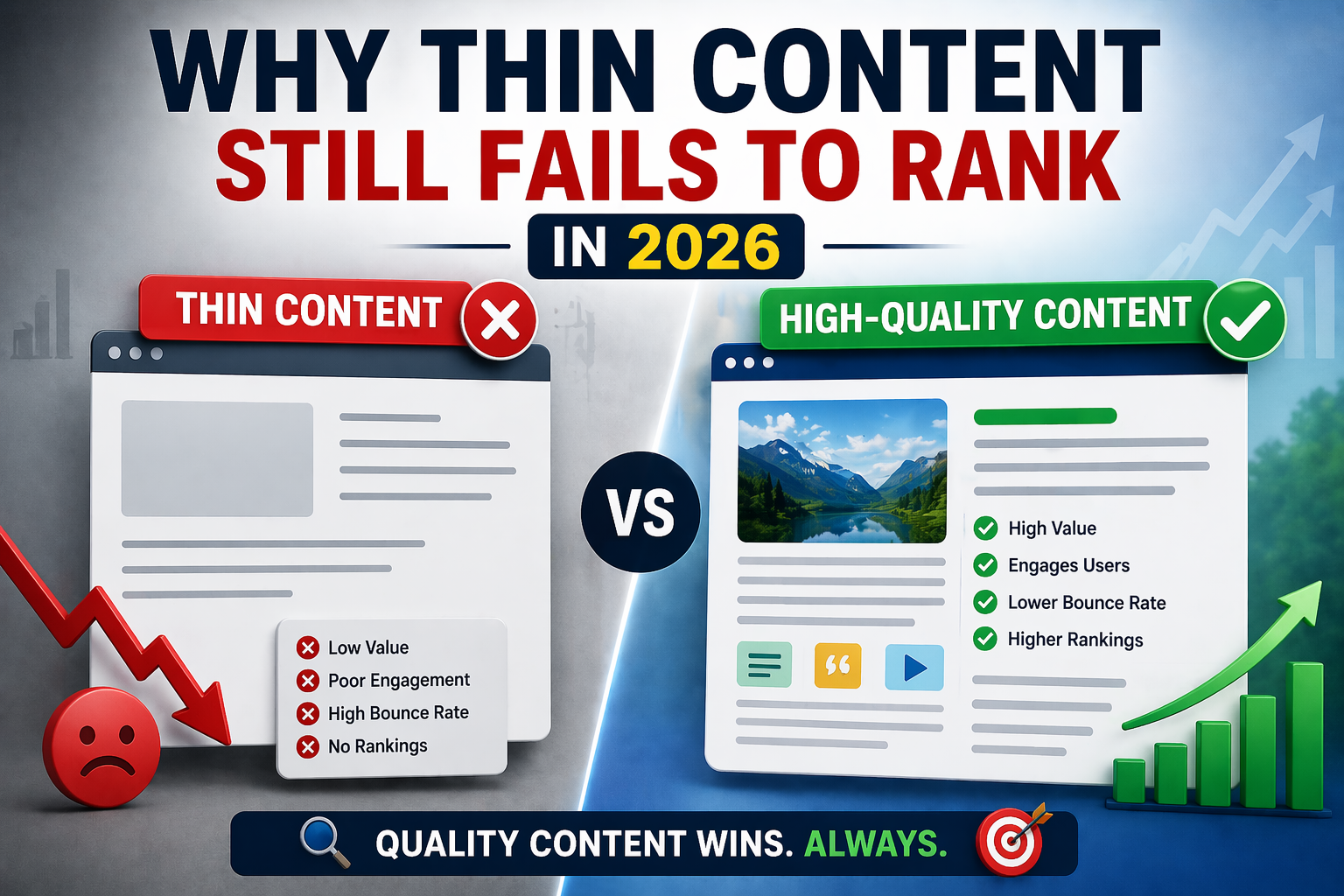
The presence of thin content on your website remains the most likely reason for your blog posts and service pages to fail at achieving search engine rankings. Users will still find search engines effective in 2026 because AI tools can create content within seconds.
The evaluation of thin content requires more than assessing its word total. The evaluation of content requires assessing its fundamental attributes which are originality and usefulness and its ability to meet the actual purpose of the content. The creation of thin content becomes possible when you write 1,500 words. The user can solve their problem completely with a 600-word page which achieves that result.
We will explain the reasons behind thin content failures and the methods which you should implement as a replacement.
What Is Thin Content in 2026?
Thin content describes webpages which provide users with minimal or no actual value. This includes:
- Very short articles with no meaningful information
- Content copied or rewritten from other websites
- Pages filled with keywords but lacking clarity
- Generic AI-generated content without real insight
- Pages that don’t answer the user’s actual query
The ability of search engines has advanced in 2026 because they can now evaluate content quality indicators beyond simple keyword identification.
Why Thin Content Still Doesn’t Rank
1. It Doesn’t Satisfy User Intent
Search engines work to display results which provide complete solutions to user inquiries. The surface-level content of your piece will make readers depart quickly which will create negative results for your website.
The user searching for “Best Dental Hospital Near Me ” expects the following immediate solutions and contact details and pricing or response time and trust signals.
User Search → Visits Page → Leaves Quickly → Low Ranking
Your page will not achieve a ranking position because it only states “We provide best services”.
In 2026, ranking equals the effectiveness with which you address user needs.
2. AI Content Saturation Raised the Bar
AI tools have created an internet environment which is filled with content. Most of the content produced by AI systems creates standard results which use similar patterns and lack unique qualities.
Search engines now prioritize:
Real experience
Unique insights
Local relevance
Helpful structure
Content which duplicates existing material will experience rejection from evaluation.
3. Lack of Topical Authority
Thin content usually exists as isolated pages. The content lacks basic knowledge and there is no actual expertise and no additional content which supports the page.
Search engines prefer websites that show:
Strong coverage of a topic
Multiple related articles
Internal linking between pages
The ranking probability decreases when you publish only one page about a particular subject.
4. Poor Engagement Signals
You cannot see engagement metrics but they hold important value.
Thin content leads to:
High bounce rate
Low time on page
No interaction
The search engines receive information that users found your website content to be unhelpful.
5. Weak On-Page SEO Structure
Thin content often lacks proper structure:
No headings (H1, H2, H3)
No clear sections
No internal links
No optimized meta tags
The lack of structure prevents search engines from grasping the material which appears on your page.
6. No Trust or Expertise Signals
In 2026, trust is critical.
The content of thin articles lacks:
Author credibility
Real examples
Case studies
Reviews or proof
Search engines prefer content that shows real-world knowledge, not just generic information.
7. Duplicate or Rewritten Content Gets Ignored
Many websites still try to rewrite existing articles and publish them as new.
This method of operation has ceased to function.
Search engines can detect:
Similar sentence structures
Repeated ideas
Lack of originality
Your content will not achieve any ranking success without presenting fresh material.
What Works Instead of Thin Content
The solution to our problem requires our attention.
1. Focus on Depth, Not Just Length
You should not pursue word count as your goal but instead complete your work.
Ask:
Did I answer all possible user questions?
Did I explain clearly?
Did I provide actionable steps?
Good content feels complete, not stretched.
2. Match Search Intent Exactly
Before writing, search your keyword and analyze:
What type of content is ranking?
What questions are being answered?
What format is used (list, guide, service page)?
Then create something better.
3. Add Real Value
This is where most websites fail.
Add:
Practical tips
Real-life scenarios
Local examples
Step-by-step solutions
Value determines the distinction between content which achieves high rankings and content which gets ignored.
4. Use Strong Structure
Make your content easy to read and understand:
Clear headings
Short paragraphs
Bullet points where needed
Logical flow
Good structure improves both SEO and user experience.
5. Build Content Clusters
Create multiple related pages which link to each other instead of creating one page.
Link them together.
The creation of website links establishes content authority.
6. Improve On-Page SEO
Every page should include:
A strong title with keywords
Optimized meta description
Proper headings
Internal links
Relevant images
These factors enable search engines to gain better comprehension about your content.
7. Add Trust Signals
To rank in 2026, your content must feel reliable.
Include:
Testimonials
Case studies
Before/after examples
Business details
Contact information
Trust increases both rankings and conversions.
8. Update Content Regularly
Outdated content becomes thin over time.
Refresh your pages by:
Adding new information
Updating statistics
Improving clarity
Expanding sections
Fresh content performs better.
Thin Content vs High-Quality Content
Thin Content:
Generic
Short or meaningless
No real value
Poor structure
No trust signals
High-Quality Content:
Detailed and helpful
User-focused
Well-structured
Unique and original
Trustworthy
The difference is clear—and search engines know it.
Thin content still fails in 2026 because search engines are smarter—and users expect more.
Ranking is no longer about publishing more pages. It’s about publishing better pages.