
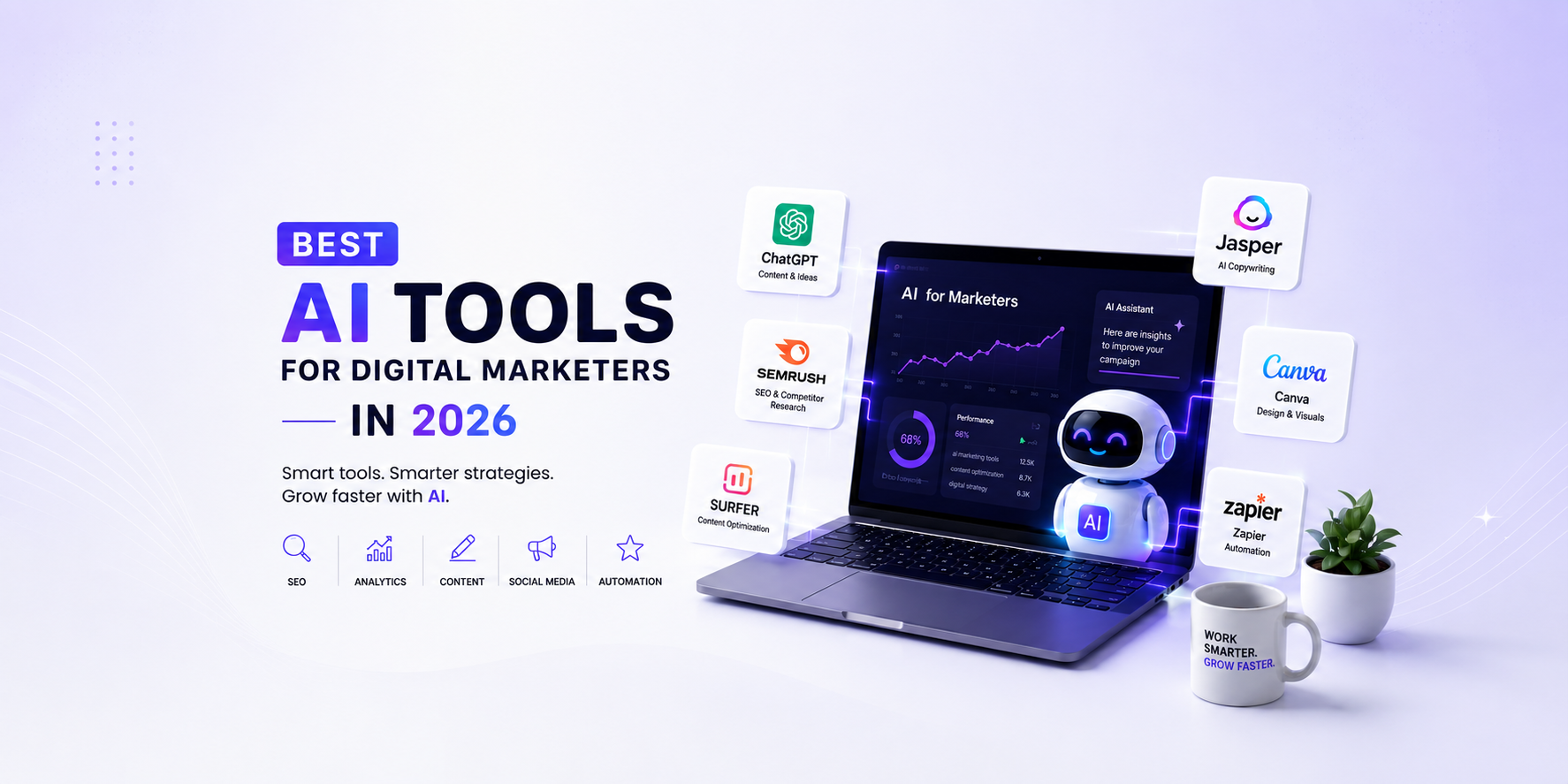
Artificial intelligence is now part of everyday marketing, and in 2026 digital marketers use AI-tools not just to save time but to sharpen strategy, craft stronger content, analyze large data faster and run campaigns more efficiently. From search optimization and content making to automation and analytics, choosing the right tools helps marketers work smarter and get better results.
If you want to keep up, using AI casually is no longer enough. The top marketers weave AI into daily routines. This quick guide looks at the best AI options for digital marketers in 2026 and how each one can back up your marketing objectives.
Why AI matters in digital marketing
AI changes how marketing works by speeding tasks and raising accuracy. It helps with keyword discovery, ad text, email tailoring, social scheduling, audience selection and tracking performance. Instead of wasting hours on repetitive chores, marketers can concentrate more on planning and creative work.
AI also boosts decision-making. Many platforms now sift through huge datasets and surface practical insights that show what performs well and what needs fixing. That lets teams tweak campaigns in near real time, improving engagement and return on investment.
1. ChatGPT
ChatGPT stays one of the most flexible AI assistants for marketers in 2026. Useful for idea brainstorming, drafting blog skeletons, creating ad text, producing email versions and polishing social captions.
Teams can also use it to rework content, explain complex subjects in simpler terms and assemble content schedules. For groups that need fast content help, ChatGPT is a solid starting place.
2. Jasper AI
Jasper AI is made with marketing content in mind. It supports long-form articles, brand voice, website copy, product descriptions and promo materials. A core strength is keeping a consistent brand tone across formats.
For agencies or internal teams, Jasper speeds up content production while keeping quality, and is particularly handy for companies that publish a lot.
3. Surfer SEO
Surfer SEO is a strong AI-driven tool for on-page SEO. It helps create pages more likely to rank by analyzing top results and recommending changes to structure, keywords and length.
This is particularly useful for SEO writers, content planners, and agencies focused on organic growth. It connects writing with ranking.
4. SEMrush
SEMrush remains a leading all-in-one platform for digital teams. In 2026 its AI additions make it even more useful for keyword work, competitive research, content tuning and PPC planning.
Marketers use SEMrush to monitor rankings, spot opportunities, audit sites and study rivals. For anyone juggling multiple campaigns, it gives a single hub for SEO and marketing intelligence.
5. Canva Magic Studio
Visual content is still crucial, and Canva’s AI features make design faster. With Magic Studio marketers can generate social visuals, adjust sizes, strip backgrounds, and make quick visual assets without deep design skills.
Canva works well for social posts, ad creatives, presentations, thumbnails and branded assets; it’s practical for teams needing speed and visual consistency.
6. HubSpot AI
HubSpot AI supports better email programs, customer grouping, lead nurturing and CRM automations. It is especially useful for businesses that rely on inbound and want sales and marketing to align.
The AI tools suggest content, automate workflows and personalize messages based on user behavior, making HubSpot a strong pick for B2B and scaling companies.
7. Copy.ai
Copy.ai focuses on short-form marketing text and automating parts of the workflow. Great for social captions, product blurbs, subject lines, landing page snippets and outreach copy.
Many marketers prefer Copy.ai because it cuts the time to create persuasive text. It’s handy when running several campaigns that need quick turnarounds.
8. Grammarly
Clear writing still counts, even with AI. Grammarly helps improve grammar, tone, clarity and consistency across documents. It’s especially useful for emails, posts, proposals and client-facing copy.
By 2026 Grammarly is more than a proofreader. It helps keep writing professional and reduces revision time.
9. Hootsuite OwlyWriter AI
Social work gets a boost from AI, and Hootsuite’s OwlyWriter helps spin up ideas, captions and post variations fast. Useful for campaign planning, keeping a steady posting rhythm and saving daily creative time.
For social managers overseeing many channels, this tool can lift productivity and cut creative fatigue.
10. Zapier AI
Zapier AI helps automate repetitive workflows across different apps. It connects tools, moves information, sends alerts and triggers actions automatically.
This is handy for lead handling, reporting, content distribution and team coordination. When set up well automation can save hours each week and lower manual mistakes.
How to pick the right AI tools
The top ai tool really depends on what you want to do. If your aim is SEO then platforms like Surfer SEO and SEMrush tend to work well, for content help you might pick ChatGPT, Jasper AI or Copy.ai which are solid choices. When it comes to social networks and visual work, Canva and Hootsuite often change the game.
Also, think about how it fits into your daily process. A tool is only useful if it slides into the way you already work and helps the team move quicker without dropping quality, or at least keeping most of it.
Conclusion
AI is not just a coming trend in digital marketing it’s already part of how many marketers plan, create, tune, and scale campaigns in 2026. The right ai helpers for online marketers in 2026 can cut down time, make content better, boost SEO and help with smarter choices.
The point is not to try every ai thing out there. Pick the few that suit your marketing aims and layer them into your workflow. That method will keep you efficient, competitive and more ready for the next steps in digital marketing.