


The year 2026 will require Canadian small businesses to adopt more advanced customer acquisition methods than simply maintaining a website. Your business has to establish its unique identity through an SEO content approach which will create local search content that supports your chosen niche and builds confidence over time.
The article shows you how to develop an SEO content strategy which Canadian small businesses can use to improve their online presence through local keywords and structured content and a repeatable process which enables confident publishing.
Step 1: Define Your SEO Goals and Audience
Before you write a single blog post, get clear on:
Your SEO goals which you want to achieve through SEO (e.g., more local leads, more phone calls, more in‑store visits).
Your ideal customer profile which includes city/region and age and needs and search habits.
For example:
- A plumbing company in Brampton uses the keywords “emergency plumber Brampton” and “water heater repair near me” to achieve its ranking goal.
- A law firm in Toronto uses the keywords “family lawyer GTA” and “Estate planning lawyer Toronto” to build its client base.
- The blog establishes lead generation capability through 1–3 defined goals which transform random content into a systematic lead generation method.
Step 2: Build a Local Keyword List (Canada‑Focused)
The initial step requires you to collect keywords which actual Canadians will search for on Google. The project requires you to gather keywords which people will use to find out about your business and search engines will generate for you.
ARRANGE YOUR MATERIAL ACCORDING TO YOUR PREFERENCES USING THE FOLLOWING METHODS.
Service pages (e.g., “Commercial cleaning services Toronto”)
Local “how‑to” guides (e.g., “How to choose a security company in Regina”)
FAQ and trust‑building posts (e.g., “What to expect from a criminal lawyer in Ontario”)
Step 3: Map Keywords to Blog Topics
Transform your keyword collection into blog topics by developing each group into a separate topic. The following example shows how to develop a blog post from the keyword “best small business accountant Mississauga.”
The post requires this content organization.
- The title includes the main keyword as its primary element.
- The introduction presents the content which the reader will understand.
- The content consists of 4-7 subheadings which respond to anticipated user inquiries.
- The conclusion provides a summary and an invitation for the reader to take subsequent steps.
- The structure enables readers and Google to digest your content in a fast manner.
Step 4: Create High‑Value, Local‑Focused Content
Your writing requires two elements which you must maintain during the process.
1. Answer a real question
You should explain how you help local people instead of describing your work.
Example:
- “Top 5 Signs You Need a Roof Inspection in Edmonton” explains the indications which show the need for a roof check in the Edmonton area.
- “3 Things to Know Before Hiring a Criminal Lawyer in Ontario” provides essential information needed before selecting a criminal lawyer in Ontario.
2. Use local dialect which gives direct access to your audience
You should use local landmarks and weather patterns and regulatory standards which directly impact your audience members.
Example line:
- “Given Vancouver’s rainy climate, it’s important to check for…”
The readers can use short paragraphs and bullet points and bolded keywords to scan the content.
Step 5: Optimize Each Blog for SEO
Every published post should include:
- The main keyword needs to be placed in the title tag which should not exceed 60 characters.
- The meta description which should be around 150 characters needs to show the exact benefits of the content.
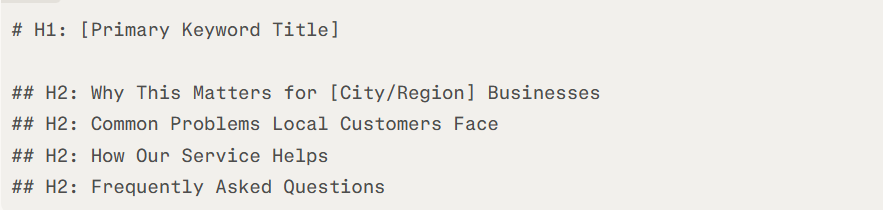
- H1 heading = post title
- H2/H3 subheadings that include keyword variations
- Links to internal content which lead to other service pages and blog posts
- The Alt text of the images needs to contain descriptive phrases which include relevant keywords.
Step 6: Plan a Consistent Publishing Schedule
You should create a straightforward content calendar to establish your writing schedule instead of writing at any time. The Canadian small businesses should follow this practical blogging schedule which includes:
- 1–2 blog posts per month focused on local topics
- 1–2 seasonal or event‑based posts each year (e.g., tax season, storm cleanup, winter prep)
Example monthly plan:
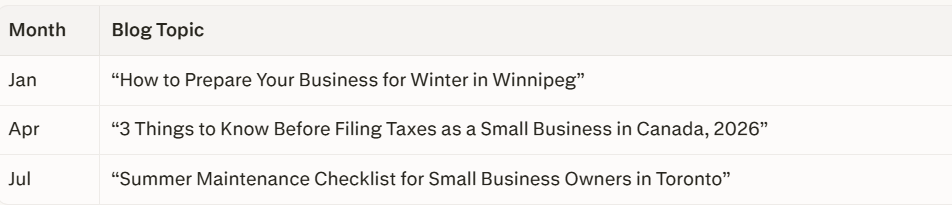
The calendar system enables you to maintain your publishing schedule because it provides an ongoing stream of prepared content.
Step 7: Promote and Track Results
Published content requires the following promotion process:
- Share the content through Google Business Profile by including a brief description and link.
- Post content in local Facebook groups or LinkedIn (if allowed).
- Send as a newsletter to your existing clients.
The process requires the following tracking activities:
- All organic traffic to each blog
- The keywords that your articles achieve higher search engine rankings for
- The blog traffic which converts into lead form submissions or phone calls
Google Analytics along with Google Search Console provides insight into successful topics which should receive expanded development.
Summary
Canadian small businesses in 2026 require an SEO content strategy which targets local customers and achieves proper search engine ranking results instead of merely needing a website. Your content transforms into a lead generation and trust building resource through your process of establishing specific objectives and creating a local keyword database and matching those keywords to useful blog content and regular content publishing.