
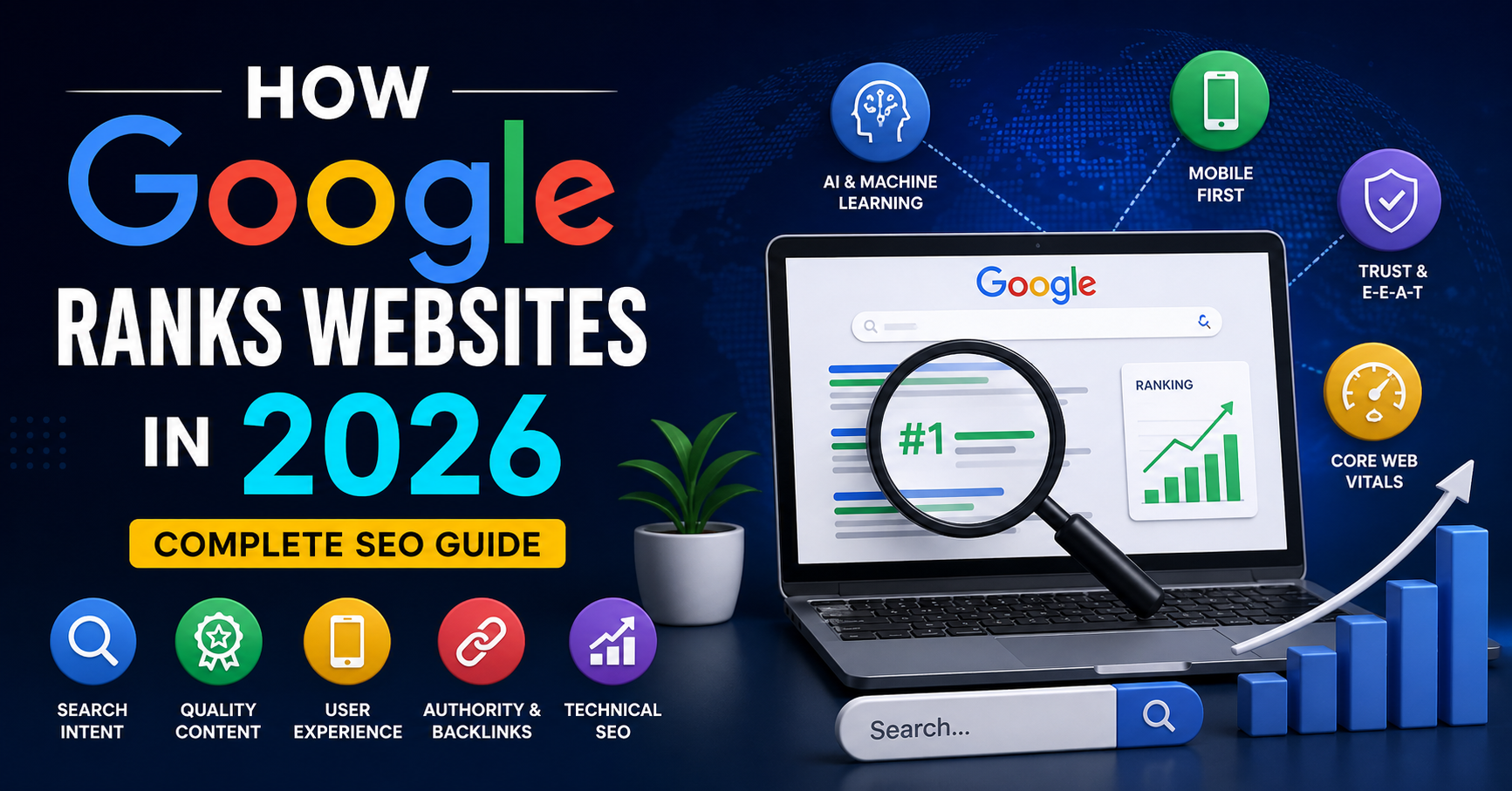
Search Engine Optimization (SEO) in 2026 is no longer about simply adding keywords to your content. Google uses artificial intelligence and machine learning together with user behavior analysis to power its advanced ranking system. Google now delivers its users the most relevant and helpful content which also meets their trustworthiness requirements.
You need to learn about Google’s website assessment process and the ranking factors which determine first-page website standings. The guide provides information about Google’s 2026 website ranking system together with effective SEO techniques which will help you increase your website ranking and obtain organic visitors.
How Google Ranking Works in 2026
Google uses advanced systems like AI models and natural language processing to understand both content and user intent. Google now uses search analysis to understand search intent instead of relying on keyword matching.
Google uses exact match search to find pages which contain all the terms that users type into their search for best SEO strategies for small businesses. Google searches for pages which deliver comprehensive and useful content that helps small businesses.
Google uses the following criteria to determine website quality:
- Relevance to the query
- Content depth and usefulness
- Website credibility
- User engagement signals
You need to provide content which goes beyond basic information to solve actual user issues.
Top Google Ranking Factors in 2026 (Detailed)
1. Search Intent Optimization
Search intent plays a critical role in modern ranking systems. Google seeks to deliver content which matches the true needs of its users.
There are four main types of search intent:
- Informational – Users want to learn something
- Navigational – Users are looking for a specific website
- Transactional – Users are ready to take action (buy, sign up)
- Commercial Investigation – Users are comparing options
Your content needs to match the exact search intent for people who will read it. Users who want to learn how Google ranks websites will search for a complete guide that explains the process instead of seeing a sales page.
How to optimize for intent:
- Analyze top-ranking pages
- Match content format (blog, list, guide)
- Answer user questions clearly
- Avoid misleading titles
2. High-Quality Content & E-E-A-T
Google gives higher importance to content which shows E-E-A-T through its demonstration of Experience Expertise and Authoritativeness and Trustworthiness.
Content requirements for 2026 demand the following items:
- Content should reflect real-world experience
- Authors should have credibility in the topic
- Information must be accurate and up-to-date
- Sources should be reliable
An SEO guide written by an experienced digital marketer will achieve better results than generic content which lacks any authoritative backing.
Ways to improve E-E-A-T:
- Add author bio
- Include real examples or case studies
- Use credible sources
- Keep content updated
3. AI & Semantic Search
Google’s AI systems now understand context relationships and meaning instead of recognizing only keywords. This process is referred to as semantic search.
You should replace repeating the same keyword with these options:
- Related terms
- Synonyms
- Topic-based content
You should use variations of Google ranking factors instead of repeating the same term throughout your text.
The following variations should be used instead of repeating the term Google ranking factors:
- SEO ranking signals
- search engine ranking criteria
- website ranking tips
This method enables Google to recognize your content in a more natural manner.
4. User Experience (UX) Signals
User experience is a major ranking factor in 2026. Google monitors user behavior to determine how people use your website.
Key UX signals include:
- Bounce rate: Do users leave quickly?
- Time on page: Are users engaging with your content?
- Click-through rate (CTR): Are users clicking your result?
Core Web Vitals (Updated):
- Largest Contentful Paint (LCP): Loading speed
- Interaction to Next Paint (INP): Responsiveness
- Cumulative Layout Shift (CLS): Visual stability
The slow performance of your website together with its difficult navigation will lead to user abandonment which results in lower search engine rankings.
5. Mobile-First Indexing
Google now ranks websites based on their mobile version first.
This means:
- Your website must be fully responsive
- Content should be easy to read on small screens
- Buttons and navigation must be user-friendly
A poor mobile experience can significantly hurt your rankings, even if your desktop site is perfect.
6. Backlinks & Website Authority
Backlinks remain a strong ranking signal but the focus is on quality over quantity.
Google evaluates:
- Relevance of linking sites
- Authority of the domain
- Natural link placement
One high-authority website backlink provides higher value than multiple low-quality backlinks.
Best ways to build backlinks:
- Guest blogging
- Creating shareable content
- Digital PR
- Outreach campaigns
7. Content Freshness & Updates
Google prefers content that is recent and regularly updated, especially for topics that change frequently.
Outdated content may lose rankings even if it was once performing well.
How to keep content fresh:
- Update statistics and data
- Add new sections
- Improve readability
- Refresh keywords
8. On-Page SEO Optimization
On-page SEO helps search engines understand your content clearly.
Important elements include:
- Keyword-rich title tags
- Engaging meta descriptions
- Proper heading structure (H1, H2, H3)
- Internal linking
- Image alt text
Well-optimized pages are easier for Google to crawl and rank.
9. Voice Search Optimization
Voice search is growing rapidly, especially with smart devices.
Users now search in a conversational way, such as:
“What are the top Google ranking factors in 2026?”
To optimize:
- Use natural language
- Answer questions directly
- Target long-tail keywords
10. Technical SEO
Technical SEO ensures your website is accessible and easy for search engines to crawl.
Key aspects include:
- XML sitemap
- Clean URL structure
- Secure HTTPS
- Schema markup (structured data)
Without proper technical SEO, even great content may not rank well.
The most recent Google algorithm updates for 2026 show two specific trends:
- AI-Powered Search Results
Google now employs AI to produce search result summaries which showcase important information. Your content needs clear structure because Google requires it for search engine results.
- Zero-Click Searches
Users obtain their answers through search engines without visiting any web pages. To maintain online presence, your website should be optimized.
How to Improve Your Google Rankings (Step-by-Step)
The process begins with keyword research as the first step.
Step 1: Keyword Research
Select keywords which:
Match user intent
Have low competition
Drive relevant traffic
Step 2: Create Valuable Content
Your content should:
Solve real problems
Be easy to read
Provide actionable insights
Step 3: Optimize Your Website
Naturally use keywords throughout your content
Enhance your website’s loading speed
Optimize all visual elements on your site
Step 4: Build Authority
Acquire backlinks from reliable sources
Establish brand credibility
Publish consistent content
Step 5: Monitor Performance
Use tools like:
Google Search Console
Google Analytics
Your website will track its visitor numbers which keyword positions users access and how they navigate through your content.
Common SEO Mistakes to Avoid
- Keyword stuffing
- Ignoring search intent
- Poor mobile design
- Slow loading speed
- Duplicate content
- Low-quality backlinks
Your rankings will improve when you stop making these specific errors.
Future of SEO Beyond 2026
SEO will continue evolving with:
- Advanced AI algorithms
- Voice and visual search
- Greater focus on user satisfaction
Websites that provide real value and excellent user experience will always win.
Conclusion
The understanding of Google’s 2026 web ranking system is essential for establishing an effective online business. The current emphasis has shifted from keyword usage to producing exceptional content which enhances user experiences and builds customer confidence.
The implementation of these strategies will enhance your search engine performance while increasing your business’s online visibility.