

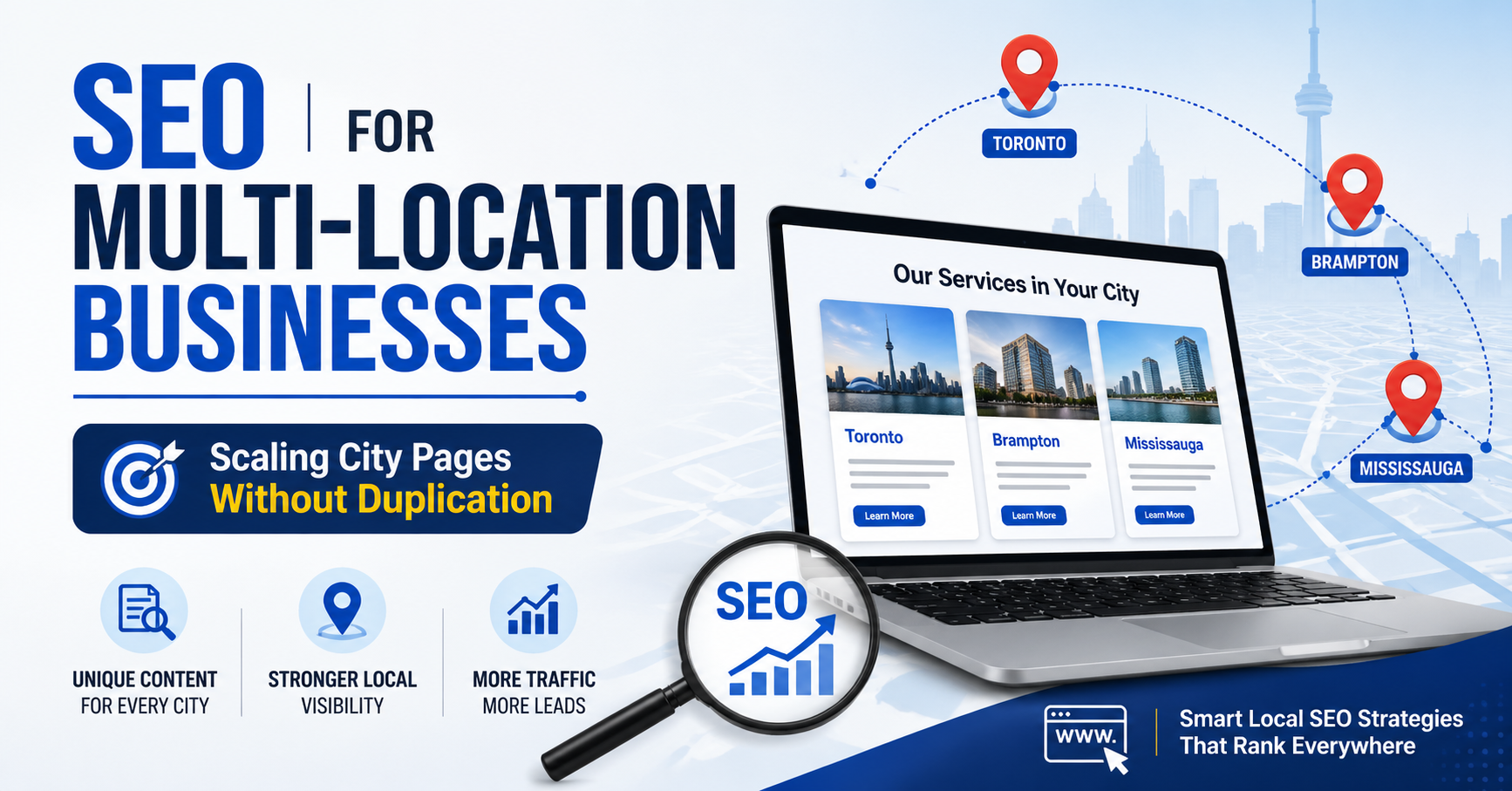
The Google duplicate content penalties create problems for companies that operate multiple locations because they need to achieve successful city rankings. The guide provides specific methods which businesses can use to develop city-specific web pages that achieve local SEO results and increase their conversion rates.
Why Duplicate City Pages Fail
The pattern of duplicate content exists when multi-location websites create multiple pages with almost identical designs which only differ through city name changes. Google and other search engines treat this as content which provides little value which results in keyword cannibalization where your own pages compete for the same terms.
The confusion causes domain authority to weaken while it uses up crawl budget resources and causes local pack rankings to decrease. The security firm faces difficulties in ranking their pages which describe “Toronto locksmith” and “Mississauga locksmith” because they use identical descriptions, which results in user frustration who need specific local information.
The situation creates a risk which leads to either manual actions or filtered search results. The solution requires websites to use hyper-local content which matches user intent so that each separate page delivers independent value.
Audit Your Current City Pages
Businesses need to examine their duplication risks before they proceed with expansion. The site should be crawled using Screaming Frog or Semrush Site Audit tools to identify templated pages which have similarity scores exceeding 80 percent.
The Google Search Console should be checked for duplicate metadata warnings while GMB insights should be reviewed to identify local performance issues which show inconsistency. The process involves pattern identification which determines whether generic H1s exist and whether service lists show identical content and whether stock photos are used throughout all images.
The team should first focus on cities which have high traffic or strong competition. The spreadsheet should show all page URLs together with their word counts and unique elements percentage and their current ranking status. The baseline information establishes the path which needs to be followed to create the new content.
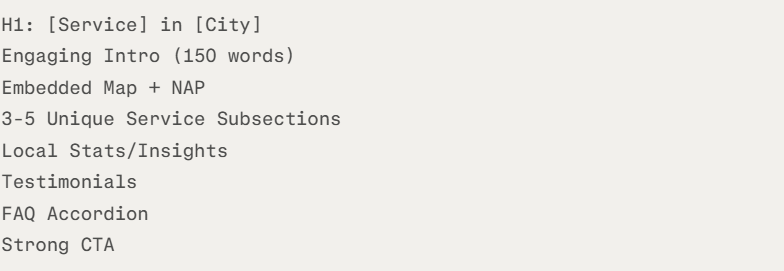
Design a Scalable Content Template
Create a template which enables flexible content creation while maintaining consistent brand identity. The core elements include Name (NAP), Address (NAP), Phone (NAP), Google Maps embed, operating hours, and primary CTAs which need to remain unchanged.
The variable sections should receive 65-75% of the content allocation.
- Hero section: H1 should use the format “[Service] in [City]:[Unique Benefit]” which includes “Emergency Locksmith Toronto: 15-Min Response Downtown”.
- Local challenges: should present solutions which specifically address city-related problems such as “High-Rise Lockouts in Toronto Condos”. The services section requires bullet points to be modified (e.g., “Pearson Airport Locksmith for Travelers” vs. “Suburban Smart Lock Installs in Oakville”).
- Proof points: should include neighborhood testimonials or mini-case studies. The FAQ block should contain 5-7 questions which include “How fast do Mississauga locksmiths arrive after hours?”.
Create this as a reusable template in WordPress or comparable CMS systems. The system should use custom fields to enable efficient variable population. The ideal word count per page should range between 1,000 and 1,800 words because that shows content with comprehensive information.
Create content that is distinctively fresh and geographically specific
Uniqueness begins through conducting research. For each city, compile:
- Top local keywords through Ahrefs (e.g., “Toronto bail hearing lawyers”).
- Industry data: Crime stats from Toronto Police, business density from StatsCan.
- Events: The Toronto International Film Festival provides entertainment security while auto shows function as venues for mechanic service operations.
- Neighborhood quirks: Yonge-Eglinton features higher condo density compared to the industrial zones found in Etobicoke.
Write original copy:
- Storytelling: “Our team secured 5 venues overnight during the last TIFF festival through our specific methods.”
- Guides: “The complete procedure for handling traffic accidents in the Greater Toronto Area is provided here for Ontario drivers.”
- Comparisons: “The security methods used in Toronto high-rise buildings show significant differences when compared to those used in Vaughan plazas.”
Batch production: Assign writers per city cluster (e.g., GTA core). Writers will receive assignment details which contain 10 keywords, 3 statistics, and 2 customer success stories. The material will undergo editing to ensure consistent voice throughout the content.
Enhance with visuals: Custom photos of your team in the city, infographics of local crime trends, or interactive maps of service radii. The content increases both user time on the site and its social media distribution rate.
Master On-Page and Technical Optimization
Differentiate metadata to dodge duplication filters:
- Titles: 50-60 characters should display “Service City Brand Local Hook” format (e.g., “Criminal Lawyer Mississauga | Fast Bail ON”).
- Metas: 155 characters should create engaging content to attract local readers (e.g., “Mississauga criminal defense: Beat charges with proven GTA lawyers. 24/7 consults.”).
- Headings: H2s should display the content through headings like “Mississauga Court Timelines Explained”.
- URLs: The correct format for URLs requires the structure /services/[service]-[city-lowercase]/ (e.g., /locksmith-toronto/).
Internal link strategically: The hub page “Our Cities” permits connections to all local pages while individual city pages establish connections through “Nearby Locations” to both service blogs and each other.
Add hreflang if international, but for Canadian multi-city, focus on LocalBusiness schema:
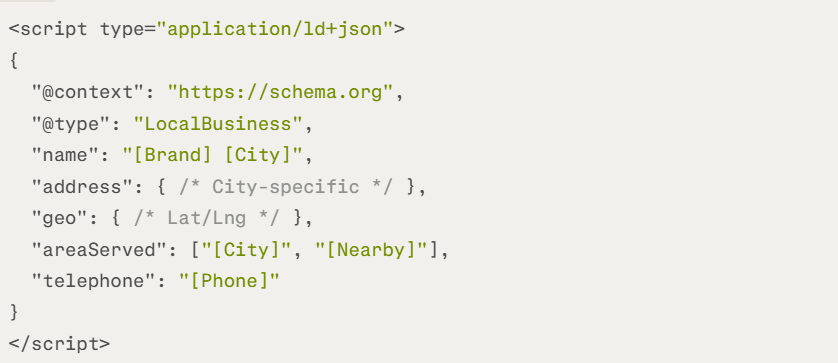
Your human-like text conversion needs to maintain all HTML elements while you transform AI-generated content into human-readable formats.
The use of canonicals should be limited to situations where content closely resembles other material and self-referential links should be used as the primary option.
Technical SEO for Multi-Location Scale
The core web vitals require Page speed to stay below 2 seconds while using lazy-loaded maps and images. Mobile-first indexing requires web designs that work on all devices.
The organization should proceed with GMB API sync implementation if their technical staff is capable of handling the task. The organization should use robots.txt to direct web crawlers towards their newly created web pages.
The monitoring process requires GSC filters which operate by tracking specific page and URL groups. The system requires alerts to notify users about 404 errors caused by incorrect redirecting.
Track, Test, and Scale
The organization now uses these measurement tools to assess their performance
- GSC: The total impressions and clicks for each city query.
- The website analytics system tracks all traffic origins and page-specific bounce rates.
- Rank trackers show the current status of local pack positions.
The organization has set three key performance indicators which include 15 percentage traffic growth per quarter and 25 percentage unique content score and 5 percentage conversion increase.
The process involves A/B testing of CTAs while content gets updated every year with data from 2026 to 2027. The organization will expand their content through 20 additional pages after achieving success with their top 5 pages.
The areas to avoid include over-optimization through natural anchors and voice search neglect by not recognizing the search term “locksmith near me Toronto” and accessibility requirements should not be ignored.
Summary and Next Steps
The process of mastering multi-location SEO requires businesses to establish templated structures which contain authentic local content that does not duplicate existing material because this approach enables law firms and security services to achieve top local rankings.